
Eco-Tourism in Madagascar: How to Travel Responsibly and Protect the Island

Disclosure: This post contains affiliate links. If you book or buy through them, we earn a small commission at no extra cost to you. Thank you for supporting Voyagiste Madagascar!
Madagascar is one of the world’s most critical biodiversity hotspots — and one of its most threatened. Over 90% of its original forest cover has been lost to slash-and-burn agriculture, charcoal production, and illegal logging. The wildlife that makes Madagascar extraordinary depends on the remaining 10% of intact habitat. Responsible tourism is not a luxury add-on in Madagascar — it is one of the most meaningful economic mechanisms for making those ecosystems financially worth protecting. This guide covers how to travel in a way that actively supports conservation, which operators and parks channel tourism funds into protection, and the on-the-ground choices that determine whether your visit helps or harms.
Understanding Madagascar’s Conservation Crisis
Scale of the Threat
Madagascar loses approximately 200,000 hectares of forest annually — an area the size of a small European country, every year. The primary driver is slash-and-burn agriculture (tavy), practiced by smallholders growing rice on burned forest margins to survive poverty. Secondary drivers include charcoal production for urban fuel, illegal rosewood logging for export to China, and climate-change-driven drought in the south. Without economic alternatives, local communities have little choice but to continue destructive land use. Tourism revenue that flows directly to local communities is one of the most effective alternatives.
Why Madagascar’s Biodiversity Matters Globally
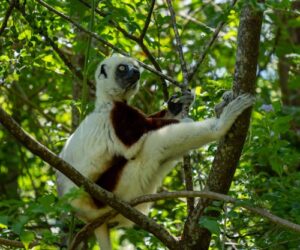
Madagascar’s ecosystems contain species found nowhere else — approximately 13,000 plant species (83% endemic), all five of the world’s lemur families, the largest chameleon diversity on Earth, and hundreds of endemic bird species. Losing Madagascar’s forests does not just affect the island — it permanently removes evolutionary lineages that took tens of millions of years to develop. The lemur family alone is the most biodiverse order of primates on Earth; their extinction would be an irreversible loss to global natural heritage.
How Tourism Funds Conservation
Madagascar National Parks (MNP) receives the majority of its operating budget from park entrance fees paid by tourists. Without this revenue, ranger salaries, anti-poaching patrols, trail maintenance, and community benefit programs would collapse. Several private reserves and conservation organizations — including Madagascar Fauna Group, Durrell Wildlife Conservation Trust, and the Rainforest Trust — operate funded largely by ecotourism revenue. Every park entrance fee, guided tour, and lodge night that channels money into these systems directly supports habitat protection.
Choosing Responsible Tour Operators
What to Look for in an Eco-Tour Operator
Responsible operators in Madagascar can typically answer these questions clearly: What percentage of guide fees goes to local (Malagasy) staff? Does the accommodation source food locally? What is the operator’s policy on wildlife interaction (no feeding, no touching wild animals, minimum approach distances)? Does the company contribute to any conservation fund or community project? Is the operator a member of a recognized sustainable tourism organization? Operators who cannot answer these questions clearly, or whose prices are suspiciously below market rate, may not be operating responsibly.
Recommended Responsible Operators
Several Madagascar tour operators are widely recognized for responsible practices: Boogie Pilgrim (Antananarivo) employs exclusively Malagasy guides and contributes to local community projects. Cortez Travel Madagascar has strong relationships with conservation organizations and local guide associations. Zara Tours operates with a community-benefit model at Andasibe. Tsara Guest House in Fianarantsoa channels profits into local education programs. These are names that appear repeatedly in responsible travel reviews — always read recent reviews from multiple sources before booking.
Private Reserves with Conservation Programs
Beyond the national park system, several private reserves combine ecotourism with active conservation. Andasibe Village community forest is managed by the local community with ranger salaries funded by entrance fees. Berenty Reserve has a long history of research and conservation alongside tourism. Anja Community Reserve near Ambalavao is entirely community-managed — 100% of entrance fees stay in the local village. Visiting community-managed reserves is among the most direct ways to ensure your tourism money reaches conservation at the ground level.
Responsible Travel Choices on the Ground
Wildlife Interaction Guidelines
Never feed wildlife — habituation to human food is one of the most damaging things visitors can do to wild lemur populations, reducing their foraging ability and increasing exposure to human-transmitted disease. Maintain minimum approach distances suggested by your guide (typically 3–5 meters for most species). Never handle wild animals except in supervised, authorized contexts (Lemur Island at Andasibe). Refuse any guide who offers to guarantee “hands-on” encounters with truly wild animals. Flash photography disturbs nocturnal species — use red-filter torches for night walks where possible. Report wildlife poaching or animal capture to Madagascar National Parks.
Supporting Local Economies
Every economic choice you make as a tourist either channels money into local communities or past them. Buy handicrafts directly from artisan cooperatives and family workshops, not from large hotels or tourist shops that often import goods or pay artisans very little. Eat at local restaurants and hotely rather than hotel restaurants. Hire local guides certified by Madagascar National Parks rather than independent operators brought in from Antananarivo. Use locally owned guesthouses rather than international chain hotels. Stay an extra night in a community where tourism is making a difference — the marginal economic impact of one extra night in the right place can fund a ranger’s weekly salary.
Minimizing Environmental Impact
Single-use plastics are a severe pollution problem in Madagascar — plastic bottles and wrappers end up in rivers, beaches, and national park trails. Carry a reusable water bottle with a filter and refill it with treated water. Carry out all your non-biodegradable waste from national parks. Use biodegradable soap and shampoo near waterways. Stay on designated trails to minimize erosion and wildlife disturbance. Avoid buying products made from endangered species (tortoise shell, coral, certain hardwoods, protected reptile skins) — these are illegal to export and directly incentivize poaching.
Travel Resources
Tours & Activities: Browse Madagascar day trips, guided excursions, and cultural experiences on GetYourGuide — instant booking, free cancellation on most tours.
More Experiences: Explore hundreds of Madagascar tours and activities on Viator — read traveler reviews and book with confidence.
Travel Insurance: Protect your Madagascar adventure with SafetyWing Nomad Insurance — affordable medical and travel coverage from $45.08/month.
Car Rental: Compare Madagascar car rental deals on Carla — find the best rates from trusted local and international agencies.
Frequently Asked Questions
Does eco-tourism actually help conservation in Madagascar?
Yes — when done properly, ecotourism is one of the most effective conservation financing mechanisms available in Madagascar. National park entrance fees fund ranger salaries and anti-poaching operations that would otherwise not exist. Community-managed reserves that derive income from tourism have measurably better forest protection outcomes than areas without tourism revenue. The key is ensuring tourism money flows to local communities and park management rather than to external operators or hotel chains that export profits.
What are the most important things I can do to travel responsibly in Madagascar?
The highest-impact actions: always pay park entrance fees (never try to avoid them — this directly funds rangers), hire locally certified Malagasy guides, eat and stay local, never feed or handle wild animals, carry out your plastic waste, buy directly from artisan communities, and choose operators with documented community-benefit and conservation programs. No single action is enough — the combination of multiple responsible choices across a two-week trip accumulates into meaningful impact.
Is eco-tourism more expensive than regular tourism in Madagascar?
Not necessarily — community guesthouses and locally certified guides are often priced comparably to less responsible alternatives. The premium for choosing responsible operators is typically 10–20%, not 100%. Community reserves often charge lower entrance fees than national parks while delivering comparable wildlife experiences. The most expensive option (international luxury lodge operated by a foreign company with profits repatriated abroad) is often the least beneficial to local conservation, while mid-range locally owned lodges frequently deliver better conservation outcomes at lower prices.
Which Madagascar organizations work on conservation that I can support?
Internationally recognized organizations working on Madagascar conservation include: WWF Madagascar (habitat protection, community livelihoods), Durrell Wildlife Conservation Trust (Madagascar Fauna Group), Rainforest Trust (protected area expansion), Wildlife Conservation Society Madagascar, and Missouri Botanical Garden (plant conservation). Local organizations include Fanamby (community-based protected areas) and Asity Madagascar (bird conservation). All accept direct donations — supporting these organizations is the highest-impact action a Madagascar traveler can take.
Are national parks in Madagascar properly protected?
National parks are better protected than unprotected forest, but enforcement resources are severely limited. Madagascar National Parks operates with an annual budget that covers roughly 25% of what would be needed for comprehensive protection. Park rangers are underpaid, under-equipped, and face enormous social pressure from surrounding communities dependent on forest resources. Tourism revenue is the most significant source of operational funding. Visiting and paying fees at national parks — especially smaller, less-visited parks — directly strengthens their operational capacity. Your park entrance fee is one of the most efficient conservation donations you can make in Madagascar.


D’après moi, Madagascar n’est pas encore près d’avoir un vol direct à partir du continent amércain…cela est-il faisable même? allez savoir… Il faudrait quasiment un genre de pétition ou quelque chose du genre pour que ça se pase…
Vous avez un beau pays. J’ai habité quelques années pour des raisons professinnelles et je vais s^^urement y retourner pour ma retraite qui s’en vient….
quelques mois…je m’excuse…