How to Photograph Lemurs in Madagascar: The Definitive Guide

Disclosure: This post contains affiliate links. If you book or buy through our links, we may earn a small commission at no extra cost to you. Thank you for supporting Voyagiste Madagascar!
There is no wildlife photography experience in the world quite like photographing lemurs in Madagascar. These primates — found nowhere else on Earth, evolving in isolation on the island for 60 million years — represent a photographically unique challenge and reward: they are neither the suspicious wild animals of most wildlife photography contexts nor the habituated, almost pet-like subjects of poorly managed tourist attractions. The best encounters fall in a compelling middle space — genuinely wild animals that have learned through generations of peaceful contact with researchers and tourists that humans represent no threat, and who continue their lives with a kind of relaxed authority in the photographer’s presence that produces images of extraordinary naturalness and intimacy. This guide distills everything a photographer needs to know to maximize their lemur photography in Madagascar: where to go, when to go, what equipment to bring, how to behave, and how to produce photographs that go beyond the snapshot.
The Best Sites for Lemur Photography
Berenty Private Reserve — The Classic Destination
The Berenty Private Reserve in the far south of Madagascar, operated since the 1930s, hosts the most famous lemur photography opportunities in Madagascar — ring-tailed lemur (Lemur catta) and Verreaux’s sifaka (Propithecus verreauxi) populations so thoroughly habituated to human presence that they approach within touching distance (though touching is not permitted and should not be attempted). Ring-tailed lemurs at Berenty perform their characteristic behaviors with complete indifference to observers: the “sunning” posture (sitting upright with arms extended to the sides to expose the belly to morning sun) is reliably photographable in the 30–60 minutes after the first light reaches the forest canopy; group grooming sessions occur throughout the day; infant lemurs cling to mothers’ backs or bellies during the February–May breeding season. Verreaux’s sifakas perform their famous “dancing” (bipedal sideways hopping across open ground) whenever crossing from one gallery forest patch to another — often multiple times daily with reliable predictability. Berenty’s open spiny forest structure (unlike the dense canopy of rainforest parks) provides excellent shooting light throughout most of the day.
Anja Community Reserve — The Accessible Alternative
Anja Community Reserve, near the highland town of Ambalavao along the RN7, provides excellent ring-tailed lemur photography in a dramatic rocky highland landscape setting that Berenty cannot match visually. The reserve’s ring-tailed lemur population (approximately 400 individuals) lives in the granite boulders and surrounding gallery forest of a reserve managed by and for the benefit of the local Betsileo community. The combination of red granite boulders, ring-tailed lemurs basking on rocky outcroppings, and highland sky creates some of the most visually distinctive lemur photographs in Madagascar — the rock-and-lemur compositions are unlike anything achievable at forest-based reserves. The reserve is accessible without flying (it is on the major overland route between Antananarivo and the south) and the entry fee directly supports community conservation. Visit in the early morning (first entry at sunrise) for the sunbathing behavior before the lemurs become more active and disperse through the reserve.
Ranomafana National Park — The Specialist’s Choice
Ranomafana National Park offers the most challenging and the most rewarding lemur photography in Madagascar for photographers willing to accept the technical difficulties of dense rainforest shooting. The park is home to twelve lemur species, including the golden bamboo lemur (Hapalemur aureus) — one of the world’s most endangered primates and found nowhere outside Ranomafana. Photographing these species requires early morning forest walks (trails open before dawn), patience as guides track habituated groups, and camera technique adapted to conditions where available light is 2–4 stops lower than in open forest environments. The reward — intimate photographs of rare, beautiful animals in genuine rainforest habitat, framed by ferns, bamboo, and cascading water — justifies everything the conditions demand. Specialized Ranomafana photography guides (distinct from general wildlife guides) who specifically understand camera operator needs — walking slowly, positioning carefully to provide shooting angles, stopping for extended periods rather than pushing on — transform the experience and its photographic results.
Technical Photography Guidance
Camera Settings for Lemur Photography
Lemur photography requires adapting to genuinely variable conditions rather than relying on fixed settings. The foundational approach: Aperture Priority mode with Auto-ISO (set a maximum ISO ceiling appropriate to your sensor — typically ISO 3200 for older cameras, ISO 6400–12800 for recent mirrorless bodies with good high-ISO performance). Set exposure compensation to +0.3 to +0.7 stops to compensate for metering systems that underexpose animal subjects against bright forest backgrounds. Use Continuous autofocus (AI-Servo/AF-C) rather than single-shot AF — lemurs move unpredictably and Continuous AF maintains tracking even during brief pauses between larger movements. Set burst rate to medium (4–6 fps) rather than maximum for general lemur shooting; reserve maximum burst rate for action sequences like the sifaka dance or ring-tailed lemur jumps. The minimum usable shutter speed for a stationary lemur is 1/250s; for a moving lemur or active behavior, use 1/800s or faster. When light is insufficient to achieve 1/800s at a reasonable ISO, accept slower shutter speeds and compensate by shooting more frames to select the sharpest.
Lens Selection and Working Distance
Lemur photography rewards having both a mid-range zoom and a telephoto available, with the specific choice depending heavily on site and species. At Berenty and Anja (highly habituated, open habitat), a 70–200mm f/2.8 zoom handles the full range from environmental portraits (at 70mm, framing the lemur within its habitat) to tight close-up portraits (at 200mm, filling the frame with a single animal’s face and hands). The f/2.8 maximum aperture is useful for subject separation in cluttered forest backgrounds. For Ranomafana (lower light, denser forest, potentially greater working distances from rare species that are not always fully habituated), a 100–400mm or 150–600mm zoom provides the reach needed to isolate subjects at 10–20m distance without approaching close enough to cause behavioral disruption. A 50mm or 85mm prime lens produces the most visually appealing “environmental portrait” results at highly habituated sites where animals can be closely approached — the wider perspective includes habitat context while maintaining subject prominence that longer focal lengths compress away.
Lighting and Composition
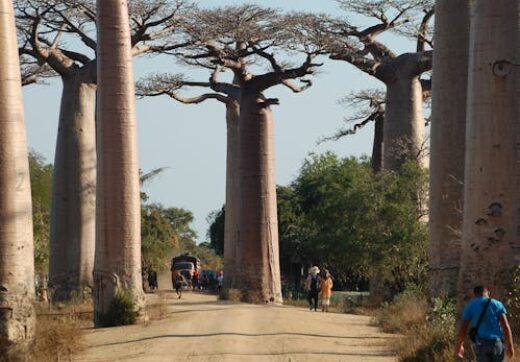
The lighting conditions for lemur photography determine everything else. In open habitats (Berenty, Anja), morning light from 7–10am and afternoon light from 3–5pm is warm, directional, and ideal. Midday light is harsh and creates strong shadows that are unflattering; use midday as the opportunity to track animals for position, save shooting for the softer hours. In forest habitats (Ranomafana, Ankarana), the canopy reduces available light dramatically and removes the directional quality of sunlight — you are working with diffuse, relatively even illumination at low levels throughout much of the day. Flash can improve this but disturbs animals and other forest users; a better approach is maximizing ISO and accepting the slightly lower image quality as the cost of natural behavior. Composition for lemur photography: use the animal’s gaze direction as a leading element (frame the lemur with space in the direction it is looking); include habitat context when it enhances the story (a sifaka in front of baobabs, ring-tails on rocky outcroppings); and exploit the eyes — lemur eyes are extraordinary (large, expressive, sometimes dramatically colored) and a sharp, well-lit eye makes a portrait regardless of the quality of the rest of the frame.
Travel Resources
Tours & Activities: Browse Madagascar tours on GetYourGuide — day trips, cultural experiences, and guided excursions.
Experiences: Explore Madagascar experiences on Viator — top-rated local tours and adventures.
Travel Insurance: SafetyWing Nomad Insurance — affordable health and travel coverage for long-term travelers.
Car Rental: Compare car rentals in Madagascar on Carla — find the best deals from top rental companies.
FAQ — Lemur Photography in Madagascar
Which lemur species are the most photogenic?
Photogenicity is subjective, but several lemur species consistently produce the most striking and memorable photographs. The ring-tailed lemur (Lemur catta) is the most instantly recognizable — its bold black-and-white ringed tail and striking black-and-white facial mask create graphic compositions that read powerfully even in small formats. The Verreaux’s sifaka is the most behaviorally spectacular — its “dancing” movement across open ground is genuinely unique in the primate world and produces photographs unlike anything achievable from other species. The indri is the most powerful visually — a large, mostly black-and-white lemur with an almost human face and a haunting territorial call that can be heard kilometers away; the indri photographed in the Andasibe-Mantadia forest setting creates images of extraordinary gravitas. The golden bamboo lemur and greater bamboo lemur of Ranomafana offer the most dramatic “endemic rarity” photographs — these are animals most of the world has never seen and that exist only in a small area of southeastern Madagascar.
Is it ethical to photograph habituated lemurs?
The ethics of habituated-lemur photography involves genuine complexity. The habituation programs that make close lemur photography possible were developed primarily for scientific research — researchers need animals that do not flee human presence to conduct behavioral studies. Tourism use of habituated animals is a secondary consequence that carries both benefits and risks. The benefits: tourism revenue funds reserve protection, community employment, and sometimes directly funds research. The risks: very high visitor numbers can stress even habituated animals (behavioral changes in heavily visited lemur groups have been documented); some visitors behave inappropriately (touching, chasing, feeding); and habituation effectively reduces survival fitness in contexts where poaching is a risk. The ethical position for photographers: visit reserves with well-managed habituation programs (Berenty, Anja, and national park habituated populations are the models); follow all guide instructions absolutely; do not pursue or attempt to manipulate animal behavior; and choose to spend money at local community-managed reserves rather than privately-managed commercial attractions wherever the options are available.
What is the best time of day for lemur photography?
For the most photogenic conditions, arrive at your lemur photography site as early as possible after first light. Ring-tailed lemurs and sifakas perform the “sunning” behavior — sitting upright with limbs extended to absorb morning warmth — for 30–60 minutes after the sun reaches their resting positions. This behavior is both unique and photographically compelling; it creates the classic “lemur portrait” images that are among Madagascar’s most recognizable wildlife photographs. After warming up, lemurs become progressively more active through the morning — foraging, grooming, social interaction — before a midday rest period (often spent in canopy shade, less accessible photographically). Late afternoon (3–5pm) brings a second peak of activity before roosting. Night walks (where the park offers them) provide completely different subjects and atmosphere — sleeping chameleons, nocturnal mouse lemurs, and nightjars replace the daytime lemur focus and produce dramatically different photographs from the same location.
How do I get sharp photographs of moving lemurs?
Sharp photographs of moving lemurs require the same technical foundations as any wildlife action photography, with some lemur-specific considerations. Shutter speed: set the minimum to 1/800s for walking or jumping animals; for the fast burst of the sifaka dance, use 1/1600s or 1/2000s if light allows. Continuous autofocus: the tracking performance of your camera’s AF system is the limiting factor for moving-lemur photography — understanding your camera’s subject-tracking behavior (how it handles partial occlusion by branches, how quickly it responds to direction changes) allows you to predict and position for moments of unobstructed subject-to-camera connection. Anticipation: the most consistently sharp moving-lemur photographs come from anticipating the action before it happens. Sifakas signal impending ground-crossing with postural preparation; ring-tails signal jumps with weight shifts. Watching behavior patterns before raising the camera — learning the pre-action signals — allows you to be ready (camera to eye, AF active, finger on shutter) at the decisive moment rather than reacting late to action you did not anticipate.
Can I print and sell photographs of lemurs taken in Madagascar national parks?
Standard park entry fees cover photography for personal use in all Madagascar national parks; they do not automatically cover commercial use. For publication, stock licensing, or any commercial purpose, you should verify the specific terms of the park’s photography policy with ANGAP before your trip. In practice, enforcement is inconsistent, but operating within proper permissions protects you legally and contributes to the revenue stream that funds park conservation — a contribution that is genuinely meaningful given the chronic underfunding of Madagascar’s national park system. For community reserves like Anja, similar commercial-use considerations apply; contact the reserve management in advance. Some reserves welcome the additional visibility that professional publication brings and will provide commercial photography permits at modest cost. For guide photography (where your images will be used in operator marketing), discuss this with the guide and reserve management before using images commercially — establishing clear expectations and agreements in advance avoids awkward post-hoc negotiations.