Why do lemurs live only in Madagascar?
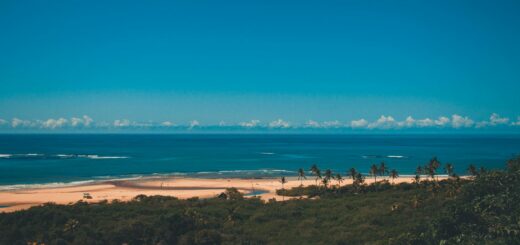
Madagascar is the “Island Continent” off the south-east coastline of South Africa by 402 kilometers. It is known to be one of the most geographically diverse islands on earth. The landscape ranges from fierce rivers, vast stretches of grasslands, magnificent beaches, majestic mountains, to dry desert lands. Many significant and endangered animal and plant species have found their home in this tropical paradise. One such creatures is the very popular “Lemur”, so famously represented in the DreamWorks’ Madagascar movie by the Lord of Lemurs himself: King Julian.
Lemurs travel from Africa to Madagascar:
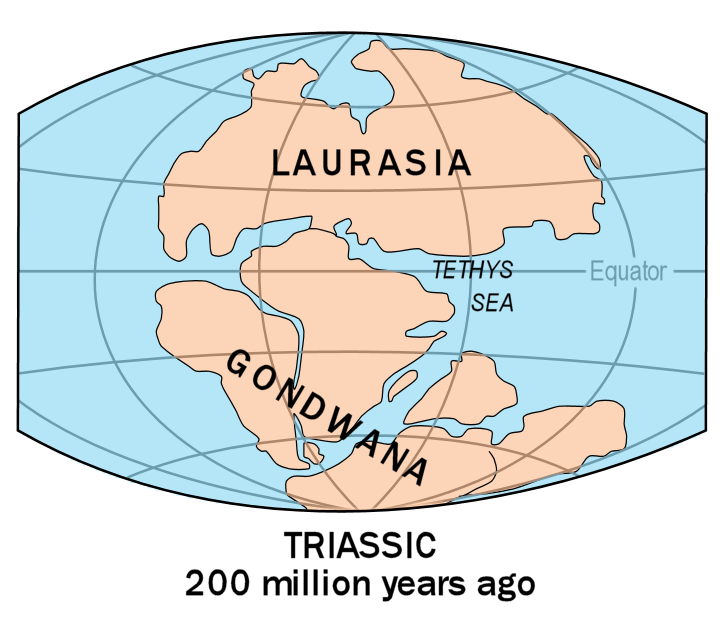
Let’s look at some (not boring) history to have our set. Imagine David Attenborough is broadcasting this. Millions of years back, Madagascar was attached to Gondwana also called Gondwanaland, the supercontinent including Africa, South America, Antarctica, the Arabian Peninsula, Australia and India. Madagascar got separated and drifted from the mainland of Africa with hundreds of kilometers between them even before the lemurs evolved. Back then, the anthropoids who were more intelligent, adaptive, dominant and larger came into being. The prosimians such as lemurs began to die out worldwide.
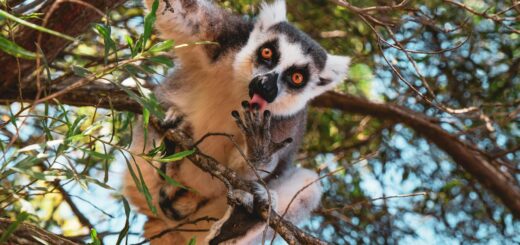
Lemurs are from the same group of primates as apes, monkeys and humans. Lemurs are insectivorous or omnivorous nocturnal (active during the night) or diurnal (active during the day) creatures. They have pointed nose, big eyes and small body size. As per IUCN – International Union for Conservation of Nature – there were a hundred and three species of lemurs that exist on 2013, all native to Madagascar Island. IUCN classified lemurs as the most endangered mammal group in the world.
Lemurs fighting : leave or die!
Back on Gondwanaland, lemurs were out-hunted in the race against other primates to find food. Thus, they had to find other ways to survive in the cruel world they were in.
The lemurs are known to have crossed over from the mainland Africa to Madagascar on large vegetation floating on the sea. (How cool is that?!). According to the latest scientific research related by Live Science, their embarkation were floating islands meaning floating clumps of vegetation carried by ocean currents. They are usually produced after major storm events.

Once in Madagascar lemurs were saved from the threat of the other primates. The isolation from primates like apes and monkeys, protected the lemurs from their main predators. Nowadays, no other primates are known to inhabit the Red Island other than them. This is one of the cause why lemurs are able to survive in Madagascar. Other than Madagascar, lemurs disappeared from the rest of the world.
Lemurs evolution:
With no competition around in Madagascar, lemurs had evolved in numerous species. The ones that were left behind became extinct as they could not win the race for food against the other primates. As per National Geographic News, a 30 million year old fossil of a Lemur was found in the Bugti Hills of central Pakistan. The found was totally unexpected and the fossil remains consist of a collection of tiny teeth that look like the teeth of Madagascar’s modern dwarf lemur, Cheirogaleus. But lemur is not found in Pakistan any more.
Lemurs now :
When human beings started to settle in the areas of Malaysia and Indonesia 2,000 years ago, the lemur population became endangered. Perceiving them as a threat, humans ended up hunting them, especially the larger ones. The largest lemur, that is now extinct, used to weigh 350 to 440 pounds (158 to 199 kg). That sure is scary…especially at night! In Madagascar, the largest lemur called Indri or Babakoto now weighs “only” 15 to 20 pounds (6.8 to 9 kilograms).
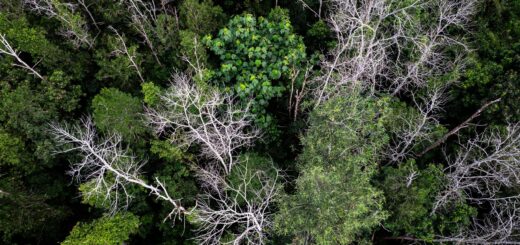
In the 1500s, when Europeans started inhabiting Madagascar, already 15 species of the lemurs had become extinct. Deforestation and hunting have destroyed their habitat and made the rest of them as endangered species.
In the 16th century, Portuguese sailors encountered lemurs for the first time when they explored Madagascar. They were frightened when lemurs woke them up in the middle of the night. They were howling and their eyes flickered in the dark. The Portuguese thought that they were the ghosts of their companions who had died. They named them “Lemurs” which is Latin for ghosts or specters, or even called “Spirits of the Night.”

Nowadays, lemurs are the best ambassadors of Madagascar anywhere in the world. They are always the star, especially among young children, in every expositions or shows that they are part of. Countless zoos are exhibiting lemurs in their permanent or special programs whether it is in North America including the United States (San Diego, Staten Island, Birmingham, Kansas City,…) and Canada (Calgary, Toronto, Montreal,…), in Europe (Germany, UK, Hungary, Austria,…) or in Asia (Singapore, Taiwan, China, Japan,…). They also have starred in the film industry like the Madagascar movie (DreamWork), Zoboomafoo by Martin and Chris Kratt; but also in numerous nature documentaries like “Island of Lemurs: Madagascar” (a Canadian-American-Malagasy nature documentary film), “Nature’s Greatest Dancers – Ring-tailed lemur” (BBC One), “Ring-Tailed Lemur” (National Geographic), and the list goes on.
At a Glance
- Where to stay: Check hotel availability on Agoda — Madagascar
- Book tours: Browse Madagascar tours on GetYourGuide
Recommended Gear for Your Madagascar Wildlife Trip
You’re Flying 10,000km to See Lemurs, Chameleons, and Fossa — Don’t Document It With a Phone Camera
Indri lemurs calling across the canopy of Andasibe. Panther chameleons in electric blue and orange. The fossa spotted on a night walk in Kirindy. A smartphone sensor in low rainforest light produces grainy, blurred images. The Sony a6400 with Real-Time Eye Autofocus locks onto animal eyes instantly — even through undergrowth and low light. APS-C sensor, 4K video, flip-up touchscreen.
Check current price and availability on Amazon →
Madagascar Has Over 100 Species of Lemur and 280 Species of Bird — You’ll Miss Most of Them Without Binoculars
Sifaka lemurs leap between canopy trees 30 metres up. The Madagascar fish eagle perches on a branch 200 metres across a lake. Without binoculars, you’re looking at distant shapes and taking your guide’s word for it. The Vortex Diamondback HD 10×42 delivers HD optical clarity with edge-to-edge sharpness. Waterproof, fog-proof, backed by Vortex’s unconditional lifetime warranty.
Check current price and availability on Amazon →
Madagascar Goes Completely Dark After Sunset — Don’t Navigate It Blind
Outside of Antananarivo’s main streets, Madagascar has virtually no street lighting. Wildlife walks in Ankarana, night lemur spotting in Ranomafana, the path to your bungalow — all navigated in total darkness. The Black Diamond Spot 400-R delivers 400 lumens with a 100-metre beam, USB-C rechargeable, IPX8 waterproof, with red night-vision mode for wildlife observation without disturbing animals.
Check current price and availability on Amazon →
Madagascar Has Some of the Highest Malaria Risk in the World
The rainforests of Andasibe, the wetlands of Morondava, the rice paddies outside every village — mosquitoes are relentless and bite at dusk and dawn. DEET burns skin and destroys gear. Natrapel 20% Picaridin is the CDC-recommended alternative that repels mosquitoes, ticks, and sandflies for up to 12 hours without damaging your equipment.
Check current price and availability on Amazon →
No Grid, No Problem — Charge Your Devices From the Sun in Madagascar’s Remote Parks
Marojejy. Andringitra. Tsingy de Bemaraha. Madagascar’s most spectacular parks are its most isolated — no power outlets, no phone signal. A 3-day wilderness circuit means running on whatever charge you left camp with. The BLAVOR Solar Power Bank pairs 10,000mAh with a fold-out solar panel that recharges itself from sunlight as you trek.
Check current price and availability on Amazon →
See lemurs in the wild
- Andasibe lemur tours — guaranteed Indri sightings in rainforest habitat
- Lemur tours on Viator — verified traveler reviews
- SafetyWing travel insurance — cover yourself for remote park visits
- World Nomads — covers adventure activities: trekking, diving, motorbikes. Compare both.
- Bradt Madagascar Travel Guide — detailed lemur habitat and park guides
Plan Your Trip to Madagascar
- Read the full Madagascar Travel Guide
- Explore itineraries by style and duration
- Best Tours and Guided Experiences
Where to Stay