Ankarana Tsingy & Caves 2026: Pinnacles, Bat Caves & the Suspension Bridge
Affiliate disclosure: This article contains sponsored links to hotels, tour operators, insurance providers, and other travel services. We earn a small commission if you book through our links, at no extra cost to you.
Ankarana Tsingy & Caves 2026 — At a Glance
- Signature highlights: jagged grey limestone tsingy pinnacles, an iconic suspension bridge over a tsingy canyon, one of Africa’s most extensive cave systems, bat colonies, cave-dwelling crocodiles, and lemur-rich canyon forests — all in one northern reserve.
- Best time to go: the dry season, roughly April to November, when tracks are passable and caves and tsingy circuits are safe to walk; the park is effectively closed or impractical during the heaviest rains.
- Guided walks: book guided tsingy & cave walks on GetYourGuide with operators who handle permits and gear.
- Plan with a local: contact Carla to tailor an Ankarana itinerary to your dates, fitness, and budget.
- Getting around: arrange a reliable car & driver via Carla for the road north from Diego Suarez and the dirt access tracks.
- Flight delays: if your flight is delayed or cancelled on the way in, you may be owed compensation — check eligibility with AirAdvisor.
- Travel insurance: caves, scrambling, and remote terrain mean cover matters — SafetyWing Nomad Insurance is built for trips like this.
- Where to stay: browse Diego Suarez stays on Agoda, the usual base for visiting Ankarana.
- Good to know: a Madagascar National Parks (MNP) guide is compulsory; bring sturdy closed shoes, a headtorch, and plenty of water — the tsingy is razor-sharp.
🐿 Wildlife-Watching Gear for Madagascar
The right kit turns a good wildlife trip into a great one:
- 8×42 binoculars — essential for spotting lemurs and chameleons in the canopy. See on Amazon →
- Rechargeable headlamp — essential for night walks; red mode won’t disturb wildlife. See on Amazon →
- Trekking poles — ultralight support for long park hikes. See on Amazon →
- Hiking daypack — comfortable pack for water, camera and layers. See on Amazon →
- Picaridin insect repellent — DEET-free protection against malaria mosquitoes. See on Amazon →
As an Amazon Associate we earn from qualifying purchases.
Ankarana National Park, in Madagascar’s far north between Diego Suarez and Ambilobe, is one of the most dramatic landscapes in the entire country. It protects a vast limestone massif that has been sculpted over millions of years into a forest of grey stone needles — the famous tsingy — riddled underneath by one of the longest cave networks in Africa. Above ground you walk along knife-edged pinnacles and cross a suspension bridge strung over a tsingy canyon; below ground you pick your way through chambers full of bats, rivers, and the legendary cave crocodiles. Between the two, sheltered canyon forests host crowned lemurs, Sanford’s brown lemurs, ring-tailed mongooses, and a long list of reptiles and birds.
What makes Ankarana special is the way it stacks so many distinct experiences into one reserve. In a single visit you can scramble over sharp Jurassic limestone, descend into a cathedral-like cave, watch lemurs leap through the canopy of a green canyon, and stand on a bridge for one of the most recognisable photographs in Madagascar. This guide walks through everything the park is known for — the tsingy itself, the Petit and Grand Tsingy circuits, the caves and their crocodiles and bats, the sacred sites of the Antakarana people, the wildlife, and the practical details you need to plan a safe, rewarding trip. For the bigger picture, pair it with our complete Ankarana National Park guide.
What the tsingy actually is
The word tsingy is often translated as “where one cannot walk barefoot,” and that captures it perfectly. Ankarana’s tsingy is a field of jagged grey limestone pinnacles, some only knee-high and others rising several metres, packed together in a maze of fins, blades, and razor edges. The rock is ancient marine limestone — laid down in the Jurassic period when this part of Madagascar lay under a shallow sea — and over enormous spans of time, rainwater that is slightly acidic has dissolved it from above and below. The result is karst at its most extreme: a surface fretted into sharp ridges and a sub-surface hollowed into caves and underground rivers.
Up close, the tsingy is genuinely sharp. Edges can slice skin and shred soft soles, which is why every guide insists on sturdy closed shoes with good grip and why walking off the marked routes is forbidden. The greyish-white colour comes from the bare limestone, sometimes stained darker by lichen and weathering, and in the right light the whole field takes on an otherworldly, almost lunar quality. Tucked between the pinnacles you’ll often find pockets of dry forest, succulents wedged into crevices, and the occasional reptile basking on a warm blade of rock. Understanding what you’re standing on — fragile, ancient, and easily damaged — is part of visiting respectfully.
The Petit Tsingy, the Grand Tsingy, and the suspension bridge
Ankarana is usually explored along a set of named circuits, and the two best known are the Petit Tsingy and the Grand Tsingy. The Petit Tsingy is the shorter, more accessible introduction: a half-day walk that takes you through a section of pinnacles, gives you your first proper look at the karst, and often includes a viewpoint over the stone field. It’s the right choice if you have limited time, are travelling with mixed fitness levels, or want a taste of the tsingy without a full day of scrambling.
The Grand Tsingy is the headline experience — a longer, more demanding circuit that takes you deeper into the massif to the densest, most spectacular pinnacles. The walk involves real scrambling, narrow passages between blades of rock, ladders or fixed aids in places, and the slow, careful footwork that sharp limestone demands. The reward is the most photogenic part of Ankarana, and at its heart is the famous suspension bridge, a slender walkway strung across a deep tsingy canyon. Standing on the bridge, with grey pinnacles falling away beneath your feet and forest filling the canyon floor, is the iconic Ankarana photograph and one of the defining images of northern Madagascar. The bridge is sturdy and properly maintained, but it sways gently and the drop below is real — it’s a thrilling crossing rather than a frightening one.
The cave system — one of Africa’s most extensive
Beneath the tsingy lies what Ankarana is arguably most famous for: an immense network of caves and underground rivers, with well over a hundred kilometres of passages mapped and more still being explored. It ranks among the most extensive cave systems on the African continent, carved out of the same limestone that forms the pinnacles above. Some chambers are vast, cathedral-like spaces; others are tight, winding tunnels; and several are threaded by permanent or seasonal rivers that disappear into the rock and re-emerge elsewhere.
A typical cave visit is an adventure but not a technical caving expedition. With your MNP guide leading and a headtorch on, you descend through an entrance and follow established routes into the dark, with some scrambling over rock and uneven ground along the way. Inside you’ll see classic cave features — stalactites and stalagmites, flowstone, and the strange acoustics of large hollow spaces — along with shafts of daylight where the roof has collapsed and let in greenery and birds. The air is cool and damp, the floor can be slippery, and a good torch (plus spare batteries) makes all the difference. Caves vary in difficulty, and your guide will match the route to your group, so it’s worth being honest about fitness and any unease in confined spaces.
Bats and the famous cave crocodiles
The caves are alive. Several chambers hold enormous colonies of bats — thousands of them roosting on the ceilings, their movement and chatter a constant presence in certain galleries. The smell and sound take some getting used to, but watching a living cloud of bats is one of the more memorable parts of a cave visit, and they play a vital role in the cave ecosystem.
Ankarana’s most celebrated residents, though, are the cave crocodiles. Nile crocodiles live in the underground rivers and pools deep inside the massif — one of very few places on Earth where crocodiles are found in a cave environment. They retreat into the caves and their permanent water during the dry season, when surface rivers shrink, and the phenomenon has made Ankarana famous among naturalists. You will not always see them, and a sighting is never guaranteed; when crocodiles are present, your guide will keep the group at a safe distance and explain where and how to look. The point is not a close encounter — it’s the extraordinary fact that these reptiles have adapted to life in the dark heart of the tsingy.
The sacred caves of the Antakarana
Ankarana is not only a natural wonder; it is a place of deep cultural significance to the Antakarana people, whose name itself means “those of the rocks.” Certain caves within the massif are sacred — used historically as places of refuge during times of conflict and as burial sites, and they remain spiritually important today. The most well-known stories tell of the Antakarana taking shelter deep in the caves during periods of war, the massif’s labyrinth of stone and underground rivers offering protection that open country could not.
Because these are living sacred sites, they are visited only with respect and according to local custom. Your guide will explain which caves can be entered, where photography may or may not be appropriate, and any fady (local taboos) that apply. Following that guidance is not optional courtesy — it is the condition on which access depends. Treating the sacred caves with the same care you’d give any place of remembrance is part of what makes a visit to Ankarana meaningful rather than merely scenic.
The wildlife you spot along the way
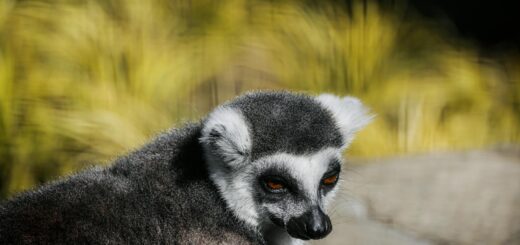
For all its rock and caves, Ankarana is a genuinely good wildlife park, thanks to the canyon forests that thread between the tsingy and surround the cave entrances. The standout sightings are lemurs: crowned lemurs (Eulemur coronatus), with their distinctive orange crown markings, and Sanford’s brown lemurs (Eulemur sanfordi) are both regularly seen moving through the trees, often in the same areas and sometimes mixed troops. Mornings around the forested canyons and near the lodges are prime viewing times.
Beyond lemurs, keep an eye out for the ring-tailed mongoose, a russet-coated carnivore that patrols the forest floor, along with a rich cast of reptiles — chameleons, geckos, and snakes — that thrive in the warm karst. Birdlife is excellent too, with northern specialities flitting through the canyon canopy and around the green pools. Because the park packs forest, rock, and water so close together, a single circuit can deliver lemurs overhead, a chameleon on a branch, bats in a cave, and birds along a canyon edge — a remarkable density of life for one walk. If wildlife is your priority, our guide to where to see lemurs in Madagascar puts Ankarana in context with the country’s other top spots.
Lac Vert, the Perte des Rivières, and the canyon forests
A few other features round out a full Ankarana visit. The Lac Vert, or green lake, is a striking pool whose colour gives it its name, tucked within the massif and reached on the longer circuits. The Perte des Rivières — literally “the loss of the rivers” — is the dramatic point where surface rivers vanish into the limestone and continue their journey underground, a vivid demonstration of how the whole karst system works as one connected hydrology of stone and water.
Then there are the canyon forests themselves: lush, shaded ribbons of greenery that grow along fault lines and collapsed cave roofs, providing the cool, moist microclimate that the lemurs and many of the park’s other animals depend on. Walking from open, blinding-white tsingy into the green hush of a canyon is one of the quiet pleasures of Ankarana, and the contrast between the harsh stone and the soft forest is a big part of the park’s character. To slot Ankarana into a wider northern itinerary, see how it compares with nearby Montagne d’Ambre National Park, the lush rainforest reserve just outside Diego Suarez.
The circuits — choosing the right walk
Ankarana offers a range of circuits, from short half-day options to full-day expeditions, and choosing well is the key to a good visit. Shorter circuits typically combine a section of Petit Tsingy with an accessible cave and a forest stretch where lemurs are likely — ideal for a first taste or for travellers who want highlights without a punishing day. Mid-length circuits add more tsingy, a longer cave, and viewpoints, while the full-day routes reach the Grand Tsingy and its suspension bridge, often combined with the Lac Vert or a deeper cave, and demand a good level of fitness and surefooted scrambling.
Distances on the map look modest, but progress over sharp, uneven limestone is slow and tiring, and heat in the dry season is significant. Discuss your group’s fitness and interests with your guide before setting off, and don’t be tempted to over-schedule — one well-chosen circuit done properly beats a rushed attempt at the longest route. If you’re deciding how Ankarana fits among Madagascar’s many reserves, our roundup of the best national parks and reserves in Madagascar helps you prioritise.
Practical tips for visiting Ankarana
A handful of practicalities make all the difference. Footwear is non-negotiable: wear sturdy, closed, well-gripping shoes that you don’t mind scuffing, because the tsingy will shred anything flimsy and a slip on sharp rock is no joke. Carry a reliable headtorch (with spare batteries) for the caves, and bring far more water than you think you need — the north is hot and the walking is harder than the distances suggest. A hat, sun protection, light long sleeves, and a small first-aid kit are all worth packing.
Visit in the dry season (roughly April to November); during the rains the access tracks become difficult, caves can flood, and many circuits are unsafe or closed. An MNP guide is compulsory and, frankly, essential — they know the routes, the cave conditions, the sacred-site protocols, and where the wildlife is. Base yourself around Diego Suarez (or a lodge near the park gates at Mahamasina) and arrange transport in advance, since the access is via dirt tracks off the main road. For timing your whole trip, our guide to the best time to visit Madagascar lines up Ankarana’s dry season with the rest of the country.
Photography and safety
Ankarana is a photographer’s dream, but it rewards preparation. The suspension bridge over the Grand Tsingy canyon is the signature shot — go early for soft light and fewer people, and keep your camera secured with a strap or in a bag while you cross, since both hands are useful on the rock. In the caves, a headtorch plus a small tripod or steady surface lets you capture the chambers; flash photography may be restricted near bats or in sacred caves, so always ask your guide first. The bright tsingy fields can fool a camera’s exposure, so expect to compensate.
On safety: move slowly and deliberately on the tsingy, test handholds before trusting them, and never step off the marked route onto the sharp rock. In the caves, follow your guide’s line exactly, watch your footing on slick surfaces, and respect any instruction about crocodile pools or unstable ground. The suspension bridge is properly built and maintained — cross one person at a time as instructed, hold the cables, and you’ll be fine. Sensible behaviour, good shoes, plenty of water, and a guide who knows the terrain turn Ankarana from intimidating into simply unforgettable.
Getting There & Travelling Well
Ankarana sits on the main road south of Diego Suarez, and most visitors fly into the north and drive out to the park gates. If your flight to Madagascar is delayed, cancelled, or overbooked, you may be entitled to compensation — it’s worth checking your claim with AirAdvisor before you write off a disrupted journey.
For a remote park built around caves, scrambling, and sharp rock, proper travel insurance is not a luxury but a basic precaution. SafetyWing Nomad Insurance is designed for exactly this kind of adventurous, off-the-beaten-track travel, covering medical care and the unexpected while you’re far from a major hospital. Given how isolated Ankarana is, having SafetyWing cover in place before you set out means you can focus on the tsingy and the caves rather than the what-ifs. Combine it with a dependable car & driver via Carla and you’ve covered the two things that most often go wrong on a northern trip — transport and the unexpected.
Plan your Ankarana trip with Carla
Putting together an Ankarana visit — choosing the right circuits, timing the dry season, arranging a guide, transport, and somewhere to stay near Diego Suarez — is exactly the kind of thing that benefits from local knowledge. Contact Carla to build an itinerary around your dates, fitness, and interests, whether you want a gentle Petit Tsingy half-day or a full Grand Tsingy and cave expedition. She can also fold Ankarana into a wider northern loop with Montagne d’Ambre and the coast. For details on bases and lodges, see our guide to where to stay near Ankarana, compare ready-made Ankarana tour packages, and check realistic figures in our Ankarana trip cost breakdown.
Frequently Asked Questions
What is tsingy?
Tsingy is a landscape of jagged, razor-sharp limestone pinnacles formed when slightly acidic rainwater dissolves ancient Jurassic limestone over millions of years, fretting the surface into blades and fins and hollowing out caves below. The Malagasy word essentially means “where you cannot walk barefoot,” which tells you everything about how sharp it is. Ankarana is one of the best places in Madagascar to experience it, with both accessible Petit Tsingy and the spectacular Grand Tsingy.
Can I go inside the caves?
Yes — visiting the caves is one of the main reasons people come to Ankarana, and your MNP guide will lead you in along established routes. A cave visit involves a headtorch, some scrambling over rock and uneven ground, and cool, damp, sometimes slippery conditions, but it isn’t a technical caving expedition. Caves range in difficulty, so your guide will match the route to your group’s fitness and comfort, and you should mention in advance if confined spaces make you uneasy.
Are there really crocodiles in the caves?
Yes. Ankarana is famous for its cave crocodiles — Nile crocodiles that live in the underground rivers and pools deep within the massif, one of very few places in the world where crocodiles inhabit caves. They retreat into the permanent cave water during the dry season when surface rivers shrink. You won’t always see them, and sightings are never guaranteed; when they are present, your guide keeps the group at a safe distance.
Is the suspension bridge safe?
Yes. The suspension bridge over the Grand Tsingy canyon is properly built and maintained, and crossing it is a thrilling rather than dangerous experience. It sways gently and the drop below is genuine, so cross one person at a time as your guide instructs and hold the cables. People with a strong fear of heights may find it daunting, but for most visitors it’s the highlight of the trip and the source of Ankarana’s most iconic photograph.
What should I wear?
Wear sturdy, closed, well-gripping shoes you don’t mind scuffing — the tsingy is razor-sharp and will destroy flimsy footwear and bare skin. Add light long sleeves and trousers for sun and rock protection, a hat, and sun cream, and pack a reliable headtorch (with spare batteries) for the caves and plenty of water for the heat. A small daypack with a basic first-aid kit and your camera secured by a strap rounds out the kit.
Ready to explore Ankarana’s tsingy and caves?
From the suspension bridge to the cave crocodiles, Ankarana rewards a little planning. Contact Carla to design your trip, arrange a guide and a car & driver, and lock in Diego Suarez stays on Agoda — then book your guided tsingy & cave walks on GetYourGuide and travel covered with SafetyWing.
Plan Your Trip to Madagascar
- Read the full Madagascar Travel Guide
- Explore itineraries by style and duration
- Best Tours and Guided Experiences
Where to Stay