Best Hotels Near Tsingy de Bemaraha: Lodges and Access Stays 2026
This post contains affiliate links. We may earn a small commission at no extra cost to you.
Essential Trekking Gear for Madagascar
Tsingy, Marojejy, Andringitra — Madagascar’s Hardest Treks Demand Proper Poles
The Tsingy needle-field requires scrambling over razor-sharp limestone. Marojejy’s Camp 3 gains 1,700 metres on muddy, root-tangled trail. Andringitra’s Pic Boby is a 4-hour vertical slog. Cascade Mountain Tech Carbon Fiber Poles are ultralight (under 500g per pair), quick-lock adjustable, sold directly by Amazon at a fraction of the cost of Black Diamond or Leki equivalents.
Check current price and availability on Amazon →
The Lightest Safe Water System on the Market — Built for Madagascar’s Remote Trek Circuits
Carrying a Grayl GeoPress on a 7-day wilderness circuit adds nearly 500 grams to your pack — every gram matters at 1,700 metres of elevation. But streams in Madagascar’s national parks are not safe to drink untreated. The Sawyer SP129 Squeeze weighs just 85 grams and filters 100,000 gallons down to 0.1 microns — removing 99.99999% of bacteria and protozoa. Sold directly by Amazon.
Check current price and availability on Amazon →
The Invisible Barrier That Keeps Malaria Mosquitoes Off Your Clothes
Your repellent only protects exposed skin — but in Madagascar’s humid evenings, mosquitoes bite through thin fabric. Sawyer Permethrin bonds to fabric fibres and kills mosquitoes on contact for up to 6 weeks and 6 washes. Treat your shirts, pants, socks, and tent before you fly — by the time you land in Antananarivo, the protection is already active.
Check current price and availability on Amazon →
Madagascar’s Rainforest Trails Are Infested With Leeches — These Keep Them Out of Your Boots
Andasibe-Mantadia, Ranomafana, Marojejy — Madagascar’s rainforest trails are where leeches thrive. They drop from leaves, emerge from wet soil, and find the gap between your sock and boot in minutes. You don’t feel them until you look down and see blood. Pike Trail Adjustable Leg Gaiters seal that gap physically, blocking leeches, mud, and water. Lightweight, waterproof, 3,600+ Amazon reviews.
Check current price and availability on Amazon →
Madagascar Goes Completely Dark After Sunset — Don’t Navigate It Blind
Outside of Antananarivo’s main streets, Madagascar has virtually no street lighting. Wildlife walks in Ankarana, night lemur spotting in Ranomafana, the path to your bungalow — all navigated in total darkness. The Black Diamond Spot 400-R delivers 400 lumens with a 100-metre beam, USB-C rechargeable, IPX8 waterproof, with red night-vision mode for wildlife observation without disturbing animals.
Check current price and availability on Amazon →
No Grid, No Problem — Charge Your Devices From the Sun in Madagascar’s Remote Parks
Marojejy. Andringitra. Tsingy de Bemaraha. Madagascar’s most spectacular parks are its most isolated — no power outlets, no phone signal. A 3-day wilderness circuit means running on whatever charge you left camp with. The BLAVOR Solar Power Bank pairs 10,000mAh with a fold-out solar panel that recharges itself from sunlight as you trek.
Check current price and availability on Amazon →
Your Hotel Room Door in Madagascar May Not Lock Properly — This Costs $16 and Fixes That
Budget guesthouses and mid-range hotels across Madagascar share one problem: flimsy door locks. Handles that wiggle, bolts that don’t catch. The Addalock slides over any standard door latch in seconds and makes your door physically impossible to open from outside — regardless of what key someone uses. No screws, no installation, 75 grams.
Check current price and availability on Amazon →
Madagascar Budget Guesthouses Often Don’t Provide Towels — Pack One That Weighs Nothing
Across Madagascar’s affordable guesthouses — especially near national park entrances — towel provision is hit-or-miss. The Rainleaf Microfiber Travel Towel dries you faster than cotton, then air-dries in under an hour in Madagascar’s heat. It packs to the size of a water bottle, weighs 200 grams, and sand doesn’t stick to it — essential for Nosy Be and Île Sainte-Marie beaches.
Check current price and availability on Amazon →
At a Glance
- Best lodge in Bekopaka: Olympe du Bemaraha — $80–130/night, pool, best meals in the area
- Best mid-range: Soleil des Tsingy — $50–80/night, comfortable bungalows
- Best budget: Chez Georget — $15–25/night, basic but reliable guesthouse
- Access window: June–November only — roads impassable December–May
- 4WD required: Mandatory — plus Manambolo River barge crossing
- Book hotels: Check Tsingy lodge availability on Agoda
- Car rental: Compare 4WD rates on Carla — standard vehicles will not reach Bekopaka
- Travel insurance: SafetyWing
Tsingy de Bemaraha is a UNESCO World Heritage Site inscribed in 1990 — a vast limestone karst plateau in western Madagascar where centuries of erosion have created a surreal forest of razor-sharp stone spires (tsingy) rising up to 70 metres from the forest floor. Access is through Bekopaka village, reached by a rough 4WD track from Morondava plus a barge crossing of the Manambolo River. The destination is only reachable June through November. Accommodation in Bekopaka is limited but well suited to the setting — small lodges with good guides, excellent meals, and dramatic stone formations visible from every terrace.
Lodges in Bekopaka Village: Your Tsingy Base Camp
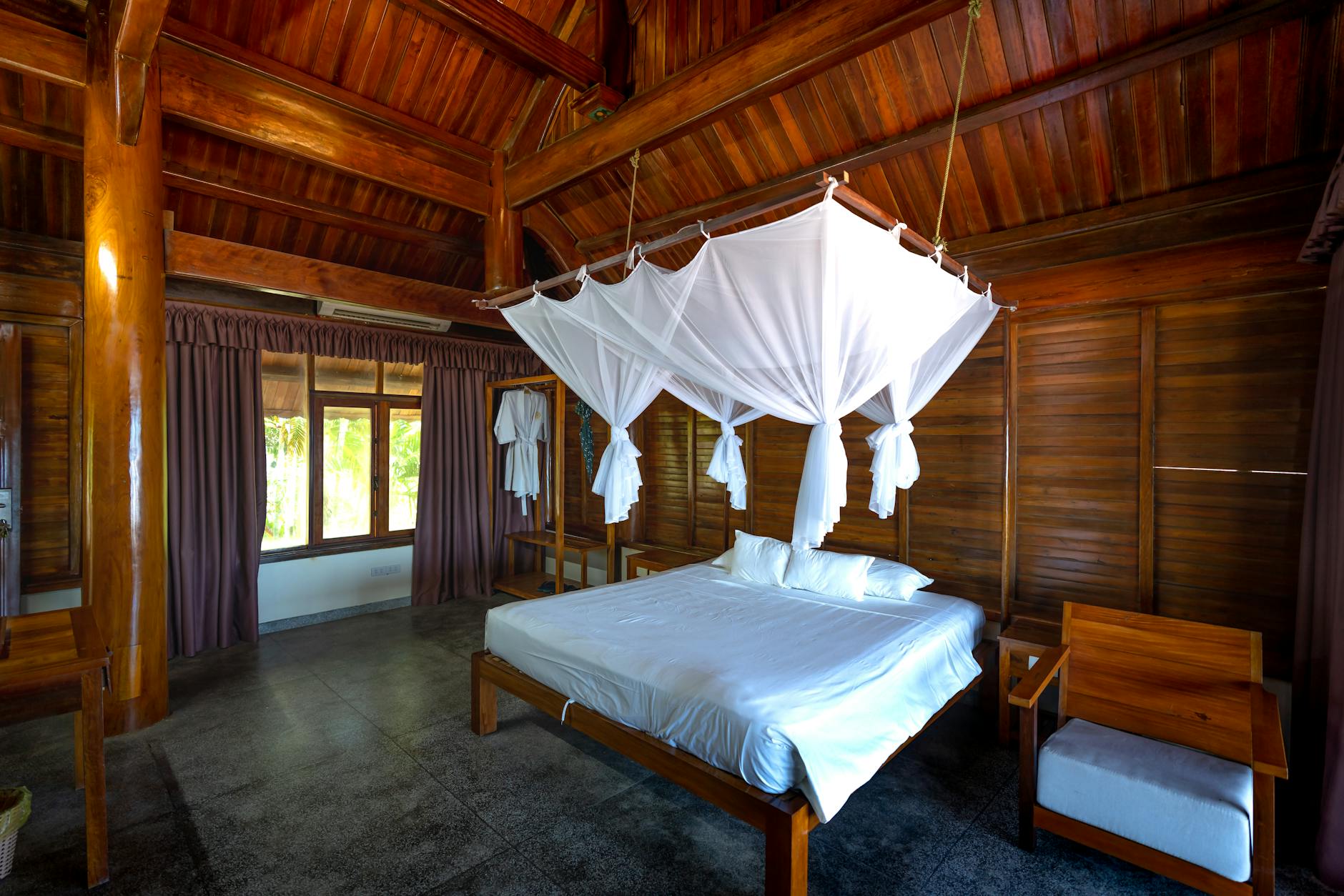
Olympe du Bemaraha is the flagship lodge in Bekopaka — the best-run property in the area, with 20 bungalows from $80–130 per night. The thatched bungalows are well-maintained, the pool is a genuine luxury after a hot day in the tsingy, and the kitchen produces consistently excellent meals using fresh produce brought in by vehicle. The lodge has its own team of certified tsingy guides who know both the Grand Tsingy and Petit Tsingy circuits in detail. Guides from this property are widely considered the best in the area for explaining the geology and endemic wildlife.
Soleil des Tsingy offers comparable quality at a slightly lower price — $50–80 per night, with comfortable bungalows, a shaded terrace restaurant, and views toward the tsingy massif. The guide team is reliable and the food is good. Both properties are located within Bekopaka village and are within walking distance of the park entrance. Bekopaka fills completely during peak weeks of July and August — book at least 4–6 weeks ahead for those dates. Check Bekopaka lodge availability on Agoda.
Budget Accommodation Near Tsingy de Bemaraha
Chez Georget is Bekopaka’s most established budget guesthouse — basic rooms from $15–25 per night, with simple Malagasy meals available. Hot water is intermittent but clean bedding and mosquito nets are standard. It is run by a local family who have hosted trekkers for many years and can connect you with trustworthy local guides at more competitive rates than the lodge operations. This is a genuine budget option — come expecting rustic rather than roughing it.
A handful of additional family guesthouses operate in Bekopaka at similar prices, opening and closing seasonally. The total accommodation capacity of the village is limited — perhaps 80–100 beds across all properties — which is why Tsingy requires more advance planning than other Madagascar destinations. If you arrive without a reservation in July or August, you may find everything full. Outside peak season (June and September–November), walk-in availability is more common. Search budget Bekopaka options on Agoda or contact properties directly by phone before traveling.
Alternative Base: Belo-sur-Tsiribihina and Miandrivazo
If you are approaching Tsingy from the north via the Tsiribihina River route, Belo-sur-Tsiribihina is the last town before the final push to Bekopaka. It has several small guesthouses ranging from $15–35 per night and serves as a practical overnight stop on the multi-day overland journey from Morondava. The town also marks the end of the classic Tsiribihina River descent (Miandrivazo to Belo), which many travelers combine with a Tsingy visit into a single 5–7 day western Madagascar loop.
Miandrivazo, further north, is the embarkation point for the Tsiribihina River pirogue descent and has basic guesthouses from $10–20 per night. Neither Belo nor Miandrivazo offers comfort comparable to Bekopaka’s lodges, but both are perfectly functional overnight stops for the route. Travelers combining the Tsiribihina river trip with Tsingy should budget 5–7 days minimum and arrange transport from Belo to Bekopaka (1.5–2 hours in a 4WD) in advance. Compare 4WD options for the full Belo–Bekopaka leg on Carla.
Getting to Tsingy de Bemaraha: 4WD Access and the Barge Crossing
Tsingy de Bemaraha is reached from Morondava — approximately 200km by 4WD track, taking 6–8 hours in dry season. The route passes through Belo-sur-Tsiribihina and requires a barge crossing of the Manambolo River at the village of Bekopaka. The barge (bac) operates during daylight hours and can accommodate most vehicles — confirm operating times with your lodge before departure, as schedules depend on water levels. The Manambolo crossing takes about 10–15 minutes. Road conditions deteriorate significantly after rain even within the June–November window, particularly in October–November.
There is no reliable road access December through May. Do not attempt this route outside the dry season window, even in a high-clearance 4WD. Compare 4WD rental rates on Carla — this is one of the most demanding drives in Madagascar and vehicle quality matters. If flying internationally to Madagascar and experiencing a delay, EU regulation EC 261 may entitle you to up to €600 — check your claim free on AirAdvisor. Bring food supplies for 2–3 days beyond what you expect to need — road delays are common.
Frequently Asked Questions
What circuits are available at Tsingy de Bemaraha?
Two main circuits exist: Grand Tsingy (approximately 4–5 hours, strenuous, involves rope bridges and ladder climbing through the karst pinnacles — the most spectacular option) and Petit Tsingy (approximately 2 hours, less technical, suitable for most fitness levels). Both circuits depart from the park entrance near Bekopaka and require a certified guide. Entry fees are set by ANGAP and typically run 45,000–55,000 MGA per adult per circuit.
Can I visit Tsingy de Bemaraha independently without a tour operator?
Yes — you do not need a package tour. Drive or hire a 4WD to Bekopaka, book accommodation directly at one of the village lodges, and hire a certified guide at the park entrance. Independent visits are common and often cheaper than packaged tours from Morondava or Antananarivo. The main cost is vehicle hire — the long rough track demands a quality 4WD, which is where most of the budget goes.
What is the absolute best time to visit Tsingy de Bemaraha?
June through September offers the best combination of driveable roads, dry weather, and manageable temperatures. July and August are peak months — expect full lodges and advance booking requirements. October and November are quieter with good road conditions in most years but occasional early-rain disruptions. June is excellent for those who want dry conditions without the August peak-season crowds.
Tsingy de Bemaraha is one of Africa’s most extraordinary landscapes — and reaching it requires genuine commitment. Plan your vehicle, book your lodge well ahead, confirm the barge crossing schedule, and build buffer days into your itinerary for road delays. The reward is a World Heritage Site that sees a fraction of the visitors of equivalent African parks. This is exactly the kind of remote, high-consequence destination where comprehensive travel insurance matters most — medical evacuation from western Madagascar costs $30,000–$80,000 without cover. Get SafetyWing before you travel —, covering emergencies, evacuation, and trip interruption anywhere in Madagascar.
Travel Insurance for Madagascar
Medical evacuation from Madagascar costs $30,000–$80,000. Don’t travel without cover.
- SafetyWing — monthly-subscription travel medical cover; you can check their plans.
- World Nomads — single-trip travel insurance with adventure-activity options.
Plan Your Trip to Madagascar
- Read the full Madagascar Travel Guide
- Explore itineraries by style and duration
- Plan a 10-Day Madagascar Itinerary
Where to Stay