How Madagascar Became an Island — the Gondwana Split
This article contains affiliate links. We may earn a small commission at no extra cost to you if you book through them.
By Jordan Lamont · Last updated 7 October 2026
At a Glance
- Split from Africa: ~165–170 million years ago
- Split from India: ~88 million years ago
- Isolated since: ~88 million years — one of Earth’s oldest island laboratories
- Result: >90% of mammals & reptiles and >80% of plants found nowhere else
- Parent landmass: the ancient supercontinent Gondwana
Say it like a local: Gondwana (gond-WAH-na), the ancient supercontinent; Madagascar is often nicknamed the “eighth continent” for how different it feels.
People call Madagascar “the eighth continent,” and it is not just marketing. The island’s lemurs, its baobabs, its chameleons and its vanished giant birds are not African, not Asian — they are their own thing, because the land they live on broke away from everywhere else before any of them existed. To understand why Madagascar is the strangest wildlife destination on Earth, you have to go back almost 200 million years, to the slow shattering of a supercontinent.
A piece of a vanished supercontinent
Madagascar was never “part of Africa” in any recent sense. It was part of Gondwana, the vast southern supercontinent that once joined Africa, South America, Antarctica, Australia and India into a single landmass. As Gondwana began to pull apart, a block carrying Madagascar, India and Antarctica tore away from Africa. The rock beneath your feet in the highlands is older than the Atlantic Ocean.
Two break-ups, eighty million years apart
Madagascar’s isolation happened in two acts. First, around 165–170 million years ago, it rifted away from the African mainland, opening the Mozambique Channel that still separates them. For a long stretch it stayed joined to India. Then, roughly 88 million years ago, India broke off too and began its long drift north toward Asia — leaving Madagascar alone in the Indian Ocean. Two great tearings, separated by nearly eighty million years, set the island adrift as an independent world.
The experiment that ran for 88 million years
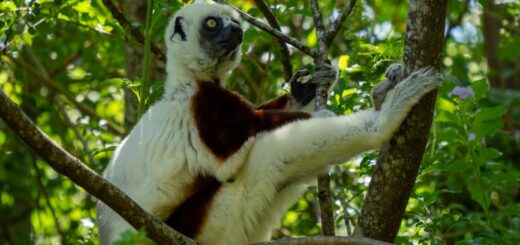
Once India left, Madagascar became a closed laboratory. Whatever plants and animals were aboard — or later rafted or flew across the sea — evolved with almost no competition or interference from continental life. Eighty-eight million years is an immense amount of time for evolution to work in private. The result is one of the highest concentrations of endemic life on the planet: more than 90% of its mammals and reptiles and over 80% of its plants exist nowhere else on Earth. Lemurs never had to compete with monkeys; baobabs branched into species found on no other continent.
Why the land itself looks the way it does
Those same rifting events shaped the scenery you travel through. The high granite spine of the central highlands, the dramatic eastern escarpment that catches the rain, the drier west and spiny south — all trace back to how the island was torn, tilted and weathered over tens of millions of years. Madagascar’s geography is not random; it is the fossil of a continental break-up.
Why it matters today
The deep-time story has a sharp modern edge. Everything that makes Madagascar extraordinary — the lemurs, the chameleons, the forests — is the product of 88 million years that cannot be repeated. Once an endemic species is gone, there is no neighbouring continent to replace it from. That is why conservation here carries a weight it does not elsewhere. Plan when to visit, and use our Madagascar travel guide to meet an island that is, quite literally, a world of its own.
FAQ
When did Madagascar separate from Africa?
Around 165–170 million years ago, as the supercontinent Gondwana began to break apart.
When did it split from India?
About 88 million years ago — Madagascar has been an isolated island ever since.
Why is Madagascar so biologically unique?
Roughly 88 million years of isolation let life evolve on its own path: over 90% of its mammals and reptiles and over 80% of its plants exist nowhere else.
Is Madagascar the oldest island?
It is one of the oldest major islands on Earth, long separated from any continent — which is exactly why its wildlife is so distinct.
Travel insurance for Madagascar
Medical evacuation from Madagascar’s interior can cost USD 30,000–80,000, so travel medical cover is worth arranging before you go. SafetyWing is the disclosed partner we mention on this site — a monthly-subscription travel medical plan. Check SafetyWing’s plans.
Plan Your Trip to Madagascar
- Read the full Madagascar Travel Guide
- Explore itineraries by style and duration
- Explore the full destination guide
Where to Stay