Madagascar Safari vs an African Safari: What’s Really Different? (2026)
Affiliate disclosure: This article contains sponsored links to hotels, tour operators, insurance providers, and other travel services. We earn a small commission if you book through our links, at no extra cost to you.
Madagascar Safari vs African Safari — At a Glance
- African safari: Big-Five game drives across open savanna — big, iconic mammals, vehicle-based
- Madagascar safari: walking forest trails for endemic lemurs, chameleons and birds found nowhere else
- The verdict: different trips for different travellers — and many wildlife lovers do both
- Book Madagascar wildlife tours: on GetYourGuide
- Plan a Madagascar safari with a local: contact Carla
- Getting between parks: car-and-driver on Carla
- Flight protection: EU261 up to €600 per passenger
- Travel insurance: SafetyWing Nomad Insurance
🎒 Madagascar Trip Essentials
A few inexpensive items make the biggest difference on the ground in Madagascar:
- Picaridin insect repellent — DEET-free protection against malaria mosquitoes. See on Amazon →
- Permethrin clothing spray — treat clothes; kills mosquitoes on contact for weeks. See on Amazon →
- Pop-up mosquito net — budget lodges rarely provide one; packs down tiny. See on Amazon →
- Water filter bottle — tap water isn’t safe to drink in Madagascar. See on Amazon →
- Universal travel adapter (USB-C) — Madagascar uses European-style plugs. See on Amazon →
- 8×42 binoculars — essential for spotting lemurs and chameleons in the canopy. See on Amazon →
As an Amazon Associate we earn from qualifying purchases.
If you have ever pictured a safari, you almost certainly pictured Africa: a dust-trailed 4WD pausing beside a pride of lions, an elephant herd crossing golden grass, the wide hush of the savanna at dawn. So when travellers start planning a wildlife trip to Madagascar, the first question is almost always the same one — is a Madagascar safari like an African safari? The honest answer is no. And once you understand why, the island stops looking like a lesser version of the Serengeti and starts looking like something genuinely its own.
This is not a ranking. A classic mainland-African safari and a Madagascar safari are two different trips, built around two different kinds of wildlife and two different ways of seeing it. One is about big, iconic mammals on open plains; the other is about small, strange, endemic creatures in dense forest, often reached on foot. This guide lays the two side by side so you can decide which fits the trip you actually want — or why a lot of seasoned wildlife travellers end up doing both. For the full picture of what a Madagascar safari involves, start with our pillar guide to the best Madagascar safari.
The Short Answer: Two Different Trips
Here is the comparison in one breath. A classic African safari is a game-viewing holiday: you sit in an open vehicle, a guide drives you across grassland and bush, and you watch large mammals — lions, elephants, buffalo, leopards, rhino, giraffe, zebra — go about their lives at a comfortable distance. The animals are big, the sightings are often dramatic, and a good amount of the big game is close to guaranteed in the right reserve at the right season.
A Madagascar safari is a discovery holiday. You walk forest trails by day and again by torchlight at night, with a guide who knows the calls and the movements, looking for animals that exist nowhere else on Earth: lemurs leaping between trees, chameleons gripping a branch at eye level, leaf-tailed geckos invisible against bark, brilliant endemic birds, frogs the colour of sweets. The animals are smaller, the encounters are more intimate, and nothing is guaranteed — which is exactly what makes a sighting feel earned.
So the short answer is: if your mental image of a safari is the Big Five from a vehicle, Madagascar will not deliver that, because those animals simply do not live here. But if what draws you is wildness, uniqueness, and the feeling of walking into the forest after something you cannot see anywhere else, Madagascar offers an experience the savanna cannot. Different trips, different travellers.
What a Classic African Safari Is
It is worth describing the mainland-African safari fairly and accurately, because it is the benchmark almost everyone is measuring Madagascar against — and it genuinely is one of the great wildlife experiences on the planet.
The heart of it is the game drive. You head out from a lodge or camp in an open-sided 4WD, usually in the cool of early morning and again in late afternoon when animals are most active. A guide and often a tracker read the bush — fresh prints, alarm calls, vultures circling — and steer you toward sightings. In the most famous reserves of East and Southern Africa, the goal is frequently the Big Five: lion, leopard, elephant, buffalo and rhino, a term that originally described the most dangerous animals to hunt on foot and survives today as the headline checklist.
The landscapes are open and expansive. The Serengeti and the Maasai Mara are vast grass plains where you can see for kilometres and watch a hunt unfold across the horizon; the great wildebeest migration moves through them on a seasonal cycle. Kruger in South Africa mixes bushveld and woodland with an excellent road network and a wide range of lodges. Across these regions the wildlife is large, charismatic and often easy to photograph from the vehicle, and the comfort level can be very high indeed — many camps and lodges sit firmly in the luxury bracket, with fine dining and pools between drives.
Crucially, the experience is vehicle-based and largely passive. You are driven; you watch. Walking safaris exist and are wonderful, but the core product is sitting in a vehicle while big animals come into view. That comfort, that reliability of sightings, and that scale of mammal are the things Madagascar does not replicate — and understanding that up front is the single most useful thing you can do before comparing the two.
What a Madagascar Safari Is
A Madagascar safari is built on a completely different premise: the wildlife here is famous not for being big but for being found nowhere else. The island broke away from other landmasses tens of millions of years ago, and its animals evolved in isolation. The result is one of the highest concentrations of endemic species on Earth — creatures that exist only on this one island.
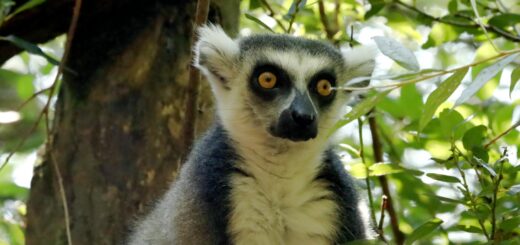
There are no lions, elephants or big cats in Madagascar. Instead there are lemurs — more than a hundred species and subspecies, from the teddy-bear indri whose haunting call carries across the rainforest, to the dancing sifaka, to the tiny mouse lemur that fits in a cupped hand. There are chameleons in abundance, from the giant Parson’s chameleon to species barely longer than a fingernail. There are leaf-tailed geckos, tomato frogs, the strange nocturnal aye-aye, and a wealth of endemic birds. Our complete guide to the lemurs of Madagascar covers the headline draw in depth.
You meet these animals on foot. In parks such as Andasibe-Mantadia, Ranomafana and Isalo, the day is built around guided forest walks on trails, with a local guide who finds animals you would walk straight past on your own. The single most distinctive part of a Madagascar safari is the night walk — many of the island’s animals are nocturnal, so after dark you set out with headtorches and watch the forest come alive with eyeshine: mouse lemurs, chameleons sleeping on twigs, hunting geckos. It is active, immersive and intimate in a way a vehicle drive rarely is.
For the full breakdown of how these guided wildlife experiences are organised — park by park, day and night — see our sibling guide to Madagascar wildlife tours. And for context on where the wildlife lives, the best national parks and reserves guide maps out the protected areas you will actually visit.
Side-by-Side: Madagascar vs Africa
The table below sets the two trips against each other across the things travellers most often want to weigh up. These are relative descriptors, not scores — neither column is “winning”. The point is to show how differently the two experiences are shaped.
| What you’re comparing | Classic African safari | Madagascar safari |
|---|---|---|
| Wildlife type | Large iconic mammals — lions, elephants, buffalo, leopard, rhino | Small endemic species — lemurs, chameleons, geckos, frogs, endemic birds |
| How you view it | Mostly from an open 4WD on game drives | Mostly on foot, day walks and night walks |
| Landscapes | Open savanna, grass plains, bushveld | Rainforest, dry forest, baobab country, tsingy karst |
| Endemism | Lower — many species range across the continent | Exceptionally high — most species exist only on the island |
| Crowds | Popular reserves can be busy; vehicles can cluster at a sighting | Far quieter trails; sightings feel private |
| Comfort | Often very high — luxury lodges, fine dining widely available | More rustic on average; comfortable but less polished |
| Physical effort | Low — you are driven and seated | Moderate — walking trails, sometimes hilly, after dark too |
| Sighting reliability | High for big game in the right reserve and season | Discovery-led — guides are skilled, but nothing is guaranteed |
| Who it suits | Travellers wanting iconic mammals, comfort and reliable drama | Travellers wanting uniqueness, active discovery and quiet wildness |
Wildlife: Endemic & Unique vs Big & Iconic
The deepest difference between the two trips is philosophical, and it comes down to two words: iconic versus endemic.
An African safari trades on the iconic. Lions and elephants are animals everyone recognises before they ever travel; seeing them in the wild fulfils an image carried since childhood. They are large, they behave dramatically, and they photograph beautifully across an open plain. The thrill is partly recognition — you are meeting the famous in person. And while many of these species range widely across the continent, that ubiquity is part of what makes them so reliably visible.
Madagascar trades on the endemic. The thrill here is not recognition but rarity — the knowledge that the indri calling overhead, or the panther chameleon turning its eyes independently, exists on this island and nowhere else in the world. You are not ticking off animals you already knew; you are meeting creatures most people have never heard of. For a traveller motivated by uniqueness rather than fame, that is a far richer payoff. It is also why Madagascar is such a magnet for serious wildlife photographers — our Madagascar photography guide goes into the subjects you simply cannot shoot anywhere else.
There is a trade-off baked into this, and it is worth being honest about it. Endemic forest wildlife is smaller and harder to spot than a herd of elephants on a plain. You will work for your sightings. But that effort is the experience — and a leaf-tailed gecko revealed on a trunk you had been staring at for a full minute lands very differently from a lion seen from a vehicle window. Neither is better. They simply reward different appetites.
How You Experience It: Walking vs Game Drives
The single biggest practical difference between the two safaris is your own body. On an African safari you are, for the most part, a seated observer; on a Madagascar safari you are a participant on your feet.
The game drive is a remarkable invention — it lets people of almost any fitness level get within metres of dangerous megafauna in safety and comfort. You are shaded, often with a cooler of drinks, and the guide does the hard work of finding and approaching the animals. It is relaxed, sociable and accessible to nearly everyone, which is a real strength of the African model.
A Madagascar safari asks more of you and gives something back in exchange. Walking a forest trail, you hear the rustle in the canopy, you smell the wet leaf litter, you feel the gradient under your boots. Your guide stops, points, and a lemur resolves out of the green where you saw nothing. At night the forest is a different world entirely, and the night walk — torchbeams catching eyeshine, the whole group hushed — is the encounter most travellers remember longest. The effort is moderate rather than strenuous in most parks, but it is real: expect uneven ground, some climbs, humidity, and a few hours on your feet at a time. If you want to picture how this fits into a wider trip, our Madagascar itinerary guide shows how walking days slot between travel days.
Landscapes: Forests, Baobabs & Tsingy vs Savanna Plains
Wildlife aside, the two trips look completely different through the windscreen and the lens.
The African safari landscape is, archetypally, the open savanna: huge skies, golden grass to the horizon, the silhouette of an acacia, perhaps a distant escarpment. It is a landscape of space and light, and it is part of why game viewing works — you can see animals at distance across the plain. Bushveld and riverine woodland add variety, but openness is the signature.
Madagascar’s landscapes are about enclosure, texture and strangeness. The eastern rainforests are dense, green, dripping and layered — you are inside the habitat rather than looking across it. The west and south give you something no savanna can: the surreal baobabs, fat-trunked and ancient, most famously lined up along the Avenue of the Baobabs near Morondava. And the tsingy of Bemaraha is a forest of razor-sharp limestone pinnacles, a landscape so alien it barely looks earthly. Add the eroded sandstone canyons of Isalo and the highland terraces, and Madagascar offers a far more varied set of backdrops than the classic plains — they are simply less open, and more often experienced from within.
Crowds, Comfort & Cost
This is where expectations most need managing, because the two trips diverge sharply on the practical texture of the holiday. All of the below is relative — we are not quoting figures.
Crowds. The most famous African reserves can get busy, and at a notable sighting it is common for several vehicles to gather around a single leopard or lion. Madagascar is the opposite: even in its best-known parks the trails are quiet, and a good sighting on a night walk often belongs to your small group alone. If solitude is part of what “wild” means to you, the island wins this one comfortably.
Comfort. Mainland Africa has had a luxury safari industry for generations, so high-end lodges, fine dining and polished logistics are widely available. Madagascar is more rustic on average. There are genuinely comfortable lodges, especially near the main parks and on the islands, but the overall standard is less uniform and the road journeys between regions are long and slow. You trade a degree of polish for a sense of frontier.
Cost. The cost profiles are different rather than simply higher or lower, and they depend heavily on how you travel. A premium African safari, with luxury camps and internal flights, sits at the top end of wildlife travel. Madagascar can be done in a more budget-conscious, independent style — though distances and the need for a car-and-driver shape the bill in their own way. For a full breakdown of what drives the numbers, see our sibling guide to Madagascar safari cost, and for travelling the island affordably overall, the Madagascar budget travel guide.
Because Madagascar has almost no reliable public transport for a wildlife trip, getting between parks means a private vehicle with a driver. Compare car-and-driver options on Carla — book ahead in the dry season, when the best guides and vehicles go first. If you want to base in the capital between forest legs, you can check Antananarivo hotel availability on Agoda before the peak months fill up.
Who Each Safari Suits
Rather than crown a winner, here is who each trip is genuinely right for.
Choose a classic African safari if you:
- Have always dreamed of seeing lions, elephants and the Big Five in the wild
- Want big, dramatic, reliable sightings without much physical effort
- Value high comfort — luxury lodges, fine dining, polished logistics
- Are travelling with very young children or anyone who cannot walk trails
- Want open-plain landscapes and the iconic safari photograph
Choose a Madagascar safari if you:
- Are drawn to wildlife that exists nowhere else — lemurs, chameleons, endemic birds
- Want an active, walking, hands-on experience over a seated one
- Love the idea of night walks and discovery-led sightings
- Prefer quiet trails and a sense of frontier over crowds and polish
- Want unusual landscapes — rainforest, baobabs, tsingy — not just plains
- Are a keen wildlife photographer chasing subjects no one else has
And honestly, plenty of travellers fit both lists — which leads neatly to the next question.
Why Not Both?
Here is the option most people never consider: you do not have to choose. Madagascar sits in the Indian Ocean off the southeastern coast of Africa, and it pairs beautifully with an East or Southern African safari into a single, once-in-a-lifetime wildlife trip.
The logic is compelling. The two experiences complement rather than duplicate each other — the Big Five from a vehicle on the plains, then the endemic forest creatures on foot on the island. You see the iconic and the unique on one journey, and the contrast actually sharpens your appreciation of each. Many keen wildlife travellers combine, for example, a few days in a Kenyan or Tanzanian reserve with a week or more on Madagascar, treating the island as the rare, harder-won half of the trip. If you would rather have the island half organised for you, our guide to Madagascar safari tour packages lays out what a ready-made trip includes.
The practicalities are manageable with planning. Routing usually runs via a regional hub such as Nairobi or Johannesburg, or via a European connection, before the final hop into Antananarivo. It is more logistically involved than a single-country safari, and it rewards working with someone who knows how the island connects to the mainland. The best time to visit overlaps well, too — Madagascar’s dry season is the prime wildlife window — so check our best time to visit Madagascar guide to line the two halves up. If a combined trip appeals, this is exactly the kind of itinerary a local specialist can sequence so neither half feels rushed.
Getting There and Travelling Well
Whichever side of the comparison you land on, reaching Madagascar means at least one international flight, and almost always a connection — typically through Paris, Nairobi or another regional hub before Antananarivo. That makes flight disruption a real planning consideration, especially on the longer combined itineraries.
Flight delayed or cancelled? Flights to Madagascar often connect through Paris or Nairobi. If your connection was on a European-routed international flight and it was delayed or cancelled, EU regulation EC 261 may entitle you to up to EUR 600 per passenger.
Check your claim free on AirAdvisor.
A walking, forest-based, sometimes-remote wildlife trip also makes travel insurance non-negotiable. Madagascar’s parks are far from major hospitals, and medical evacuation from a remote region can cost USD 30,000 to USD 80,000 — a single fact that justifies cover many times over. SafetyWing Nomad Insurance is straightforward for long and flexible trips, and is built for exactly this kind of multi-stop, active travel. If you are combining Madagascar with a mainland African safari, make sure your policy covers every country on the route — and set up SafetyWing cover before you leave home rather than after the first delay.
Because both walking days and long road transfers carry their own minor risks — uneven trails, slow rural roads, remote stretches — a good policy is as much a part of the kit as your boots. We always recommend reading the fine print, then getting covered with SafetyWing well ahead of departure.
Plan Your Madagascar Safari with a Local Specialist — Carla
Deciding between an African safari, a Madagascar safari, or a combination of the two is exactly the kind of question that benefits from honest, on-the-ground advice rather than a brochure. Carla is a Madagascar-resident travel specialist who can tell you frankly whether the island matches what you want from a wildlife trip — and, if it does, sequence the parks, the night walks and the transfers so the whole thing flows. Reach out to Carla to talk through your ideas, or to scope a combined Africa-and-Madagascar itinerary. Sort your SafetyWing cover once the plan is set.
Frequently Asked Questions
Is a Madagascar safari like an African safari?
No — and that is the point. A classic African safari means Big-Five game drives across open savanna, watching large mammals from a vehicle. A Madagascar safari means walking forest trails by day and night to find endemic lemurs, chameleons and birds found nowhere else. They are different trips for different travellers.
Are there lions or elephants in Madagascar?
No. Madagascar has no lions, elephants, or other big African mammals — they never reached the island after it separated from other landmasses. Its wildlife evolved in isolation, which is why it is dominated by endemic species like lemurs and chameleons rather than the megafauna of the mainland.
Which is better, Madagascar or an African safari?
Neither is better — they suit different appetites. Choose mainland Africa for big iconic mammals, high comfort and reliable sightings; choose Madagascar for uniqueness, active forest walks, night wildlife and quiet trails. Many wildlife lovers do both, because the experiences complement each other.
Can you combine Madagascar with an African safari?
Yes, and it is a superb pairing. Madagascar lies off the southeastern coast of Africa and connects via hubs such as Nairobi or Johannesburg. Travellers often combine a few days in an East or Southern African reserve with a week or more in Madagascar’s forests. It takes more planning, so working with a local specialist helps.
Is a Madagascar safari physically demanding?
It is more active than an African game-drive holiday but not extreme. Most wildlife is seen on guided forest walks — including night walks — with uneven ground, some hills and humidity. The effort is moderate in most parks; reasonable fitness and a willingness to walk a few hours at a time are all you need.
🌍 Decide If a Madagascar Safari Is Right for You — Ask Carla
A Madagascar-resident specialist can tell you honestly whether the island suits what you want from a safari. Reach out to Carla.
Plan Your Trip to Madagascar
- Read the full Madagascar Travel Guide
- Explore itineraries by style and duration
- Explore the full destination guide
Where to Stay