Where to See Baobabs in Madagascar 2026: The Avenue, the Spiny Forest & the Far North Compared
Affiliate disclosure: This article contains sponsored links to hotels, tour operators, insurance providers, and other travel services. We earn a small commission if you book through our links, at no extra cost to you.
Where to See Baobabs in Madagascar 2026 — At a Glance
- The icon: the Avenue of the Baobabs near Morondava (west) — the giant Grandidier’s baobabs, unforgettable at sunset
- The spiny forest: Ifaty and Mangily near Tuléar (southwest) — the squat, red-barked Fony baobabs of the Reniala reserve
- The rare species: Diego Suarez and the far north — Perrier’s and the Suarez baobab, for the enthusiast
- The sacred tree: Mahajanga (northwest) — the great African baobab, a revered landmark
- When: dry season (April–November) for passable roads, clear light, and the trees at their leafless, sculptural best
- Find tours: GetYourGuide Madagascar
- Flight protection: EU261 €600 per passenger on disrupted European inbound flights
- Travel insurance: SafetyWing Nomad Insurance — essential for the long western drives
- Where to stay: Madagascar stays on Agoda
🐿 Wildlife-Watching Gear for Madagascar
The right kit turns a good wildlife trip into a great one:
- 8×42 binoculars — essential for spotting lemurs and chameleons in the canopy. See on Amazon →
- Rechargeable headlamp — essential for night walks; red mode won’t disturb wildlife. See on Amazon →
- Trekking poles — ultralight support for long park hikes. See on Amazon →
- Hiking daypack — comfortable pack for water, camera and layers. See on Amazon →
- Picaridin insect repellent — DEET-free protection against malaria mosquitoes. See on Amazon →
As an Amazon Associate we earn from qualifying purchases.
Baobabs grow across the dry regions of Madagascar, but they are far from evenly spread — different species occupy different corners of the island, and the experience of seeing them varies enormously from place to place. The giant Grandidier’s baobabs of the Avenue near Morondava are the headline, but the squat Fony baobabs of the southwestern spiny forest, the rare trees of the far north, and the great sacred African baobab of Mahajanga each offer something quite different. This guide walks through the main baobab destinations, what makes each special, which species you’ll see, and how to choose between them or combine them — so you can plan the baobab experience that suits your trip. For the species themselves, see our types of baobabs guide, and for the full overview, our complete baobabs of Madagascar guide.
For most travellers, the choice comes down to how much time you have and where else you’re going. The Avenue near Morondava is the essential baobab sight and the easiest to reach, sitting within the classic western circuit alongside the Tsingy and the wildlife of Kirindy. The southwest, around Tuléar and Ifaty, pairs the spiny-forest baobabs with beaches and reefs. The far north is for the dedicated, folded into a wider northern trip. Below, we take each region in turn, then help you decide which is right for you. For where these regions sit in the bigger picture, see our western Madagascar guide and northern Madagascar guide.
The Avenue of the Baobabs & Morondava (West)
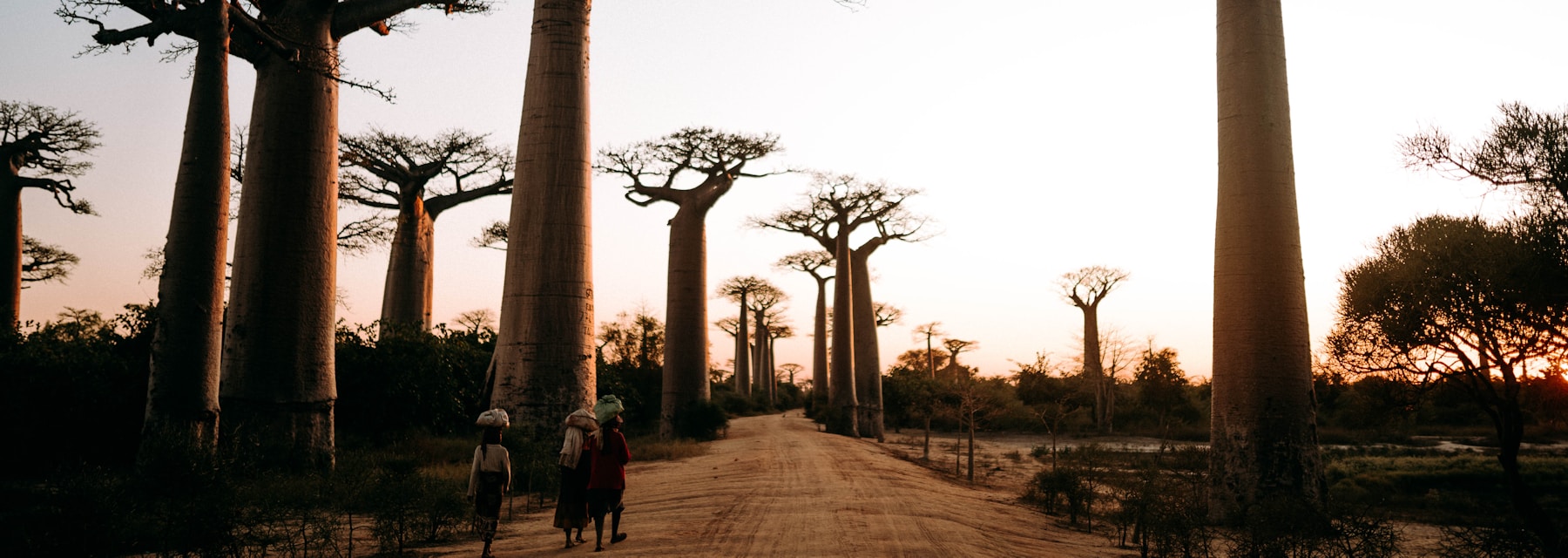
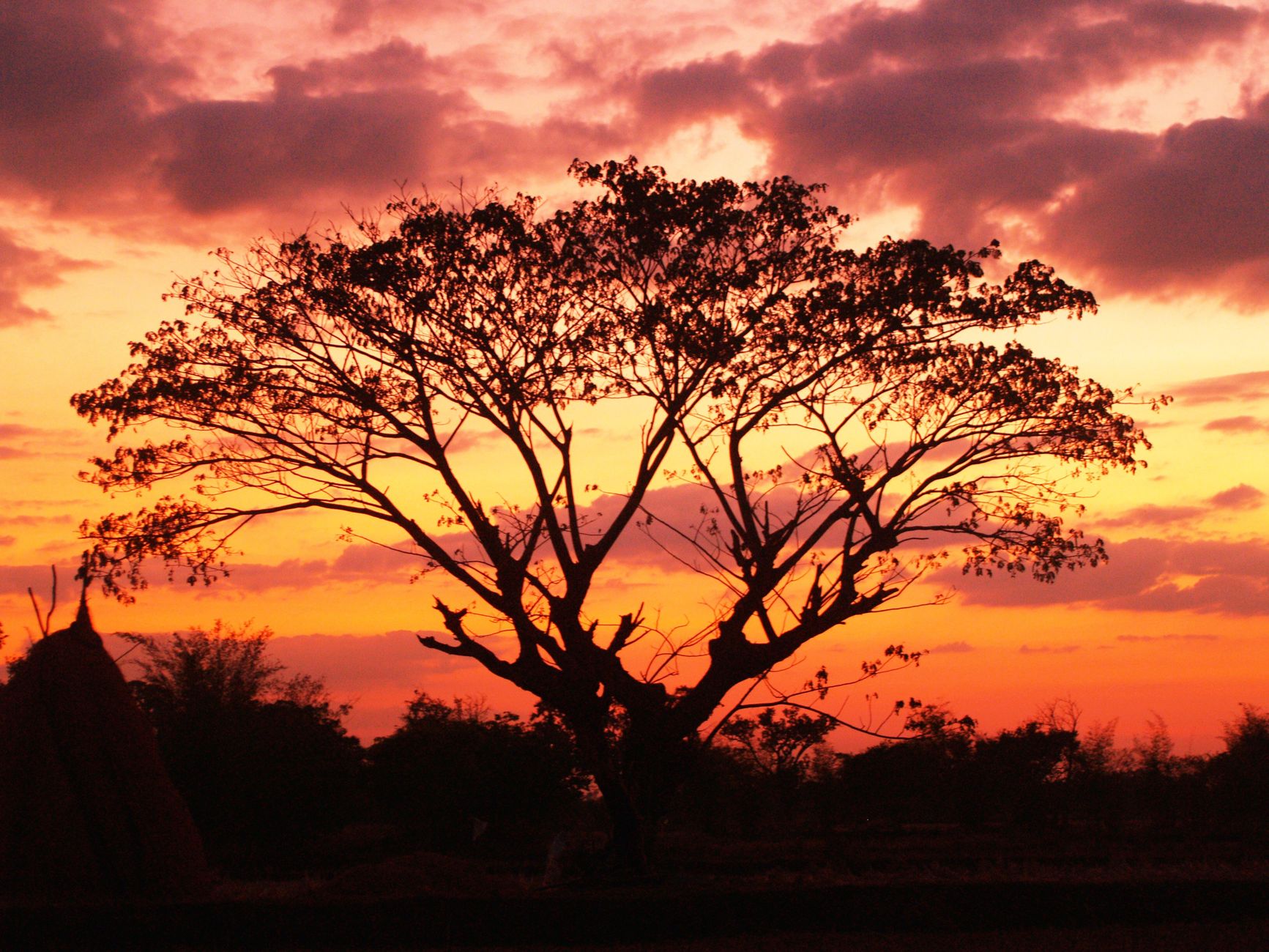
The Avenue of the Baobabs, near Morondava on the west coast, is the single most famous baobab sight in Madagascar and, for most travellers, the essential one. A line of towering Grandidier’s baobabs — giants up to thirty metres tall, with smooth grey trunks and flat-topped crowns — flanks a dirt road, and at sunrise and especially sunset the scene is unforgettable: the low sun turning the trunks to gold, long shadows across the red earth, and the silhouettes of the giants against a flaming sky. It is the image that defines Madagascar, and standing among the trees as the light changes is, for many, the highlight of their trip. Nearby is the Baobab Amoureux, two trees grown twisted together, the subject of a local legend of love.
The Avenue is reached from Morondava, a coastal town served by short domestic flights from Antananarivo, or by a long overland drive. Morondava itself has beaches and a range of places to stay, making it a comfortable base for the Avenue and the wider western circuit. The classic approach is to base in or near Morondava, visit the Avenue for sunset (and ideally a quieter sunrise), and combine it with Kirindy and, for the adventurous, the Tsingy de Bemaraha. Check Morondava-area stays on Agoda — the dry-season months are busy, so book ahead. This is the most accessible, most spectacular, and most popular baobab destination, and for most first-time visitors it is the one to prioritise. See our Avenue of the Baobabs complete guide.
A few practicalities make the Avenue better. It is busiest at sunset, when tour groups converge for the golden light, so arriving early to choose your spot — or coming for the much quieter sunrise — pays off, and many travellers do both, staying nearby so they can be there for each. The site itself is a stretch of road rather than a fenced park, so you can walk freely among the trees, though efforts to protect the Avenue and manage visitors have grown as its fame has spread. The drive out from Morondava is short and the experience needs only an hour or two, but the light is everything, so the timing matters more than the distance. Allow a full evening for the Avenue, and consider spending two nights in the Morondava area so a cloudy sunset isn’t your only chance — the difference between a grey sky and a flaming one is the difference between a nice photo and the image of a lifetime.
Kirindy & the Dry West
Within the western circuit, the Kirindy Forest — between Morondava and the Tsingy — is a dry deciduous forest reserve famous above all for the fossa, Madagascar’s largest predator, and for Verreaux’s sifaka, the “dancing” lemur, alongside baobabs scattered through the woodland. It is easily combined with the Avenue and adds a genuine wildlife dimension to a baobab trip, with night walks turning up nocturnal lemurs and other creatures. While the baobabs here are not the dense, postcard rows of the Avenue, the experience of seeing them amid living dry forest, with lemurs and the chance of a fossa, is a richer one than the roadside giants alone. Browse western Madagascar wildlife tours on GetYourGuide to pair the baobabs with Kirindy’s wildlife. For the wider region, see our western Madagascar guide.
Ifaty, Mangily & the Reniala Reserve (Southwest)
The southwest, around Tuléar (Toliara) and the beach villages of Ifaty and Mangily, offers an entirely different baobab landscape: the spiny forest, one of the strangest plant communities on Earth, where squat, red-barked Fony baobabs grow among octopus trees, swollen pachypodiums, and aloes, all adapted to extreme drought. The Reniala reserve near Ifaty is the classic place to walk among them, a short, easy trail through this otherworldly forest, often combined with birdwatching. The Fony baobabs here are smaller than the western giants but often more characterful — gnarled, bottle-shaped, intensely photogenic — and the spiny forest around them is a botanical wonder in its own right.
The southwest’s great advantage is that it pairs the baobabs with beaches and reefs: Ifaty and Mangily are beach resorts on a reef-fringed coast, so you can combine the spiny-forest baobabs with snorkelling, diving, and seaside relaxation. Tuléar is reached by short domestic flight from Antananarivo or as the end of the long RN7 overland route through the south. Check Tuléar and Ifaty stays on Agoda — the beach lodges fill up in the dry-season peak. This is the baobab destination for travellers who want to combine the trees with a relaxed coastal stay, and a quite different, more intimate baobab experience than the Avenue.
The Reniala reserve walk is short and gentle — an hour or two on flat, sandy trails — and a good local guide brings the spiny forest alive, pointing out the baobabs, the bizarre Didierea octopus trees, the medicinal plants, and the birds, including some southwest specialities sought by birdwatchers. Because the trail is easy and the setting so photogenic, Ifaty suits families and travellers who want a low-effort but genuinely memorable baobab experience, with a beach to return to afterwards. Many visitors pair a morning in the spiny forest with an afternoon of snorkelling on the reef, making the southwest one of the most relaxed and rewarding ways to see baobabs — the trees in the cool of the morning, the sea in the heat of the day.
Diego Suarez & the Far North (Rare Species)
The far north, around Diego Suarez (Antsiranana), is the realm of Madagascar’s rarest baobabs — Perrier’s baobab and the Suarez baobab, both critically endangered and very localised, surviving in the dry forests and limestone country of the region, alongside Adansonia madagascariensis. This is baobab territory for the dedicated enthusiast rather than the first-time visitor: seeing the rare species takes more effort and local guidance, and the trees are fewer and less concentrated than the Avenue’s giants. But for travellers keen to see beyond the famous western baobabs — and to encounter two of the world’s most threatened trees — the far north is the essential region.
The north has much else to offer alongside its rare baobabs: the Amber Mountain rainforest, the red tsingy, the Ankarana caves and pinnacles, the Emerald Sea, and the beaches of nearby Nosy Be. So a far-north baobab quest folds naturally into a wider northern adventure. Diego Suarez is reached by domestic flight from Antananarivo. Check Diego Suarez stays on Agoda. For the full region, see our northern Madagascar guide.
Be realistic about what a far-north baobab trip involves. The rare species grow in scattered fragments of dry forest and on limestone slopes, sometimes reached only by a guided excursion on rough tracks, and you will not find the dense, dramatic rows of the Avenue here — the reward is the species themselves, and the satisfaction of seeing trees that very few travellers ever do. For that reason, the far north makes most sense for return visitors, keen naturalists, and anyone already drawn north by Amber Mountain, Ankarana, and the beaches, who can fold a rare-baobab excursion into a richer itinerary. A specialist guide who knows where the surviving Perrier’s and Suarez baobabs stand is essential here, far more than at the well-trodden Avenue, and is the difference between finding the rare trees and missing them entirely.
Mahajanga & the Northwest (the Sacred African Baobab)
Mahajanga (Majunga), the port city of the northwest, is home to the great sacred baobab — an enormous, ancient African baobab (Adansonia digitata), many metres around, that is a revered civic landmark and a focus of local reverence. It is an easy and rewarding stop for travellers passing through the northwest, and a chance to see the one non-endemic baobab species alongside the famous Malagasy ones. Mahajanga also serves as a gateway to the Ankarafantsika National Park, with its dry forest, lemurs, and birdlife. Check Mahajanga stays on Agoda. While not a baobab destination on the scale of the Avenue, the sacred tree of Mahajanga is a memorable sight and a cultural landmark well worth seeking out if your travels bring you to the northwest. Locals will happily tell you its legends, and seeing the offerings left at its base brings home, more vividly than any single giant in the wild, just how deeply these trees are woven into Malagasy life.
Photographing Madagascar’s Baobabs
For many travellers, the baobabs are above all a photographic subject, and a little planning transforms the results. Light is everything. The trees are at their best in the warm, low light of sunrise and sunset — the “golden hours” — when the trunks glow and long shadows give the scene depth; the harsh midday sun, by contrast, flattens everything and bleaches the sky. At the Avenue, the classic shot places the giants against a colour-saturated dusk sky, often with a passing ox-cart or a figure for scale, while the quieter dawn offers softer light and mist. Plan to be in position before the light peaks rather than arriving as it fades.
Each region rewards a different approach. The Avenue suits wide, graphic compositions — the row of trunks receding down the road, reflections in the rainy-season pools, silhouettes against the sky. The spiny-forest Fony baobabs of Ifaty reward closer, more intimate work, capturing the gnarled, sculptural trunks among the strange surrounding plants. A wide-angle lens is invaluable for the giants, a longer lens for compressing rows of distant trees, and a tripod helps in the low light of dawn and dusk. Beyond gear, the best baobab photography comes from patience and timing — being there for the right light, on the right evening, which is exactly what a well-planned trip and a knowledgeable local guide deliver.
Visiting Responsibly
Several of Madagascar’s baobabs are threatened, and the landscapes around them are fragile, so how you visit matters. Keep to paths and boardwalks at managed sites like Reniala, where straying damages the thin soils and the plants; don’t climb or carve the trunks, which harms the trees and offends local custom; and respect sacred baobabs, following your guide’s lead near revered trees, where particular behaviours may be subject to local fady (taboos). Paying park and reserve fees willingly, hiring local guides, and supporting community initiatives all channel the value of your visit into protecting the trees and supporting the people who live alongside them. Responsible visiting is not a constraint but part of what makes the experience meaningful — your presence, done thoughtfully, becomes one of the reasons these ancient giants are still standing. For the wider conservation picture, see our complete baobabs guide.
Which Baobab Destination Is Right for You?
The choice between the baobab regions comes down to what you want and where else you’re travelling:
- For the iconic experience — the Avenue near Morondava (west). If you want the classic, postcard baobab sight and have limited time, this is the one: the most famous, most accessible, and most spectacular, easily combined with Kirindy and the Tsingy.
- For baobabs plus beaches — Ifaty and Mangily (southwest). The spiny-forest Fony baobabs paired with a relaxed reef-fringed coast — ideal if you want to combine the trees with snorkelling and seaside downtime.
- For the rare species — Diego Suarez and the far north. The dedicated enthusiast’s choice, for Perrier’s and the Suarez baobab, folded into a wider northern adventure of mountains, tsingy, and beaches.
- For the sacred tree — Mahajanga (northwest). The great African baobab, an easy and rewarding stop if your travels take you through the northwest.
For most travellers, the Avenue is the priority and often the only baobab destination on a first trip; the southwest is the natural choice for those combining baobabs with a beach stay; and the far north is for return visitors and enthusiasts. There is no single “best” — it depends on your time, your interests, and your wider route.
It also helps to think about how much time the baobabs themselves need, separate from getting to them. The actual baobab experiences are short — an evening at the Avenue, a morning at Reniala, a guided excursion in the north — so the time you allocate is mostly travel and the other attractions of each region. As a rough guide: the Avenue can be slotted into a western circuit without adding days of its own, since you are passing through Morondava anyway; the southwest baobabs add little time to a beach stay or the end of an RN7 trip; and only the far-north rare species really demand dedicated effort. This is why baobabs almost always feature as a highlight within a wider trip rather than as the sole reason to travel — and why a well-planned itinerary can deliver three or four species without ever feeling like a botanical expedition unless you want it to.
Combining Baobab Destinations
While few travellers visit Madagascar solely for baobabs, the trees combine beautifully with the rest of a western, southern, or northern trip. The western circuit — Morondava, the Avenue, Kirindy, and the Tsingy de Bemaraha — is the classic baobab-and-wildlife combination. The RN7 overland route through the south ends at Tuléar and the southwest spiny forest, so the Fony baobabs of Ifaty are a natural finale to a southern road trip taking in Ranomafana, Isalo, and more. And the far north weaves its rare baobabs into an adventure of mountains, caves, and beaches. Seeing the full range of all six endemic baobab species means combining west, southwest, and far north over a longer, more ambitious itinerary — a genuine baobab expedition. For sequencing these regions, see our baobab tour packages guide.
To make this concrete, a popular baobab-rich western loop runs roughly like this: fly Antananarivo to Morondava; spend an evening (and ideally a dawn) at the Avenue of the Baobabs; visit Kirindy for the fossa, sifakas, and dry-forest baobabs; and, for the adventurous, push on over rough tracks to the Tsingy de Bemaraha before returning to Morondava to fly back — four to six days that deliver the giants, the wildlife, and the limestone pinnacles in one circuit. Travellers on the southern RN7 route, meanwhile, finish at Tuléar and add the Fony baobabs and beaches of Ifaty as a natural coda. A good operator will tailor the length and pace to your interests and the dry-season road conditions, so the baobabs slot into a trip that flows rather than feeling rushed.
When to Visit
For all the baobab regions, the dry season (April–November) is strongly preferred. In the west especially, the dirt roads to Morondava and beyond to the Tsingy are far easier in the dry months and can become difficult or impassable in the rains (December–March). The dry season also brings clear light for sunrises and sunsets, and the trees stand leafless and sculptural — the classic, iconic look. The southwest and the far north are likewise best in the dry season. Within that long window, the trees themselves look much the same, so timing is about the roads, the light, and combining the baobabs with the rest of your trip. The shoulder months at either end of the dry season can be especially pleasant, with quieter sites and softer light, while the absolute peak brings the busiest sunsets at the Avenue. See our best time to visit guide for the full picture.
Getting There and Travelling Well
The baobab regions are reached from Antananarivo by short domestic flight (to Morondava, Tuléar, or Diego) or by long overland drive. International flights connect via Europe, the Gulf, or Africa; book early and protect them — EU261 entitles you to up to €600 per passenger for long delays, cancellations, and denied boarding on European routes. Register your inbound flight for EU261 coverage with AirAdvisor. Within Madagascar, the western and southern roads are long and rough, so most travellers use a vehicle with a driver-guide or the short flights; compare car and 4WD rental prices on Carla if travelling independently, and book ahead in the dry-season peak.
Comprehensive travel insurance is essential, covering the long drives, the remote regions far from major hospitals, and any combined wildlife, trekking, or watersports activities. Coverage should include medical evacuation, trip cancellation, and your activities. SafetyWing Nomad Insurance offers flexible, affordable cover well suited to a Madagascar trip — confirm it covers remote-area evacuation before you travel.
Carla / Voyagiste Madagascar (plan your baobab trip)
Madagascar-resident specialist who can build a trip around the baobab destinations you most want to see. Contact Carla directly to plan an itinerary — a western circuit with the Avenue and Kirindy, a southwest spiny-forest-and-beach trip, or a far-north quest for the rare species — with the flights, the long drives, the lodges, and the timing all handled. Local knowledge ensures you reach the best baobabs at the best light.
Frequently Asked Questions
Where is the best place to see baobabs in Madagascar?
The Avenue of the Baobabs near Morondava, on the west coast, is the most famous and accessible — the giant Grandidier’s baobabs, unforgettable at sunset. See our Avenue of the Baobabs guide.
Where can I see the small “bottle” baobabs?
In the spiny forest of the southwest, around Ifaty and Mangily near Tuléar — the squat, red-barked Fony baobabs of the Reniala reserve, among octopus trees and other strange endemic plants.
Where are the rarest baobabs?
In the far north, around Diego Suarez — Perrier’s and the Suarez baobab, both critically endangered and very localised. This is a destination for the dedicated enthusiast. See our northern Madagascar guide.
Can I combine baobabs with beaches?
Yes — the southwest around Ifaty and Mangily pairs the spiny-forest baobabs with reef-fringed beaches, and the far north’s rare baobabs sit near the beaches of Nosy Be.
When is the best time to see baobabs?
The dry season (April–November), when the western roads are passable, the light is clear, and the trees stand leafless and sculptural. See our best time to visit guide.
Do I need travel insurance?
Yes — essential, covering the long western drives and medical evacuation from remote regions. Comprehensive coverage is a must; confirm it covers your activities.
🧭 Plan Your Madagascar Baobab Trip With Carla
The Avenue at sunset, the spiny-forest Fony baobabs, the rare trees of the far north — wherever you want to see them. Reach out to Carla, our Madagascar-resident specialist, to build a baobab trip with the right regions, the best light, and the timing all handled.
Plan Your Trip to Madagascar
- Read the full Madagascar Travel Guide
- Explore itineraries by style and duration
- Best Tours and Guided Experiences
Where to Stay
Go deeper — Insider Madagascar
Our cultural series on the stories behind the island: