Frogs of Madagascar: The Complete Guide 2026
Affiliate disclosure: This article contains sponsored links to hotels, tour operators, insurance providers, and other travel services. We earn a small commission if you book through our links, at no extra cost to you.
Frogs of Madagascar 2026 — At a Glance
- Why it’s special: 300+ frog species, around 99% found nowhere else — and only frogs, no native toads or salamanders
- The stars: the jewel-like mantellas, the red tomato frogs, and hundreds of Boophis tree frogs
- Where & when: eastern rainforests (Andasibe, Ranomafana), on night walks, best in the wet season (Nov–March)
- Book a wildlife / night-walk tour: on GetYourGuide
- Plan a frog-watching trip with a local: contact Carla
- Getting there: arrange a car & driver on Carla
- Flight protection: EU261 up to €600 per passenger on disrupted European inbound flights
- Travel insurance: SafetyWing Nomad Insurance
- Where to stay: Madagascar stays near the parks on Agoda
Step into an eastern Madagascar rainforest after dark and the first thing you notice is the sound. Long before your torch beam picks out anything moving, the night is thick with calls — a layered chorus of clicks, whistles, trills and bell-like pings rising from the leaf litter, the stream margins and the dripping canopy overhead. Almost all of it is frogs. Madagascar is one of the great amphibian arks of the planet, and a wet-season night here is one of the most intense frog experiences anywhere on Earth, even if many visitors arrive thinking only of lemurs and never realise the soundtrack around them belongs to creatures the size of a thumbnail.
That richness is no accident. Isolated for tens of millions of years, Madagascar’s frogs have radiated into a dazzling cast of jewel-bright day-active species, plump red novelties, and hundreds of nocturnal tree frogs — the overwhelming majority of them found nowhere else. This guide is the pillar of our frog-and-amphibian series: what makes them special, the main groups you’ll meet, where and when to find them, the conservation pressures they face, and how to build a trip around them. If you’re new to the island’s wildlife, it pairs naturally with our complete guide to the lemurs of Madagascar.
Why Madagascar Is an Amphibian Wonderland
The headline numbers are extraordinary. More than 300 frog species have been formally described from Madagascar, and researchers widely agree that many more remain undescribed — new species are still being named regularly as scientists work through the island’s forests and DNA libraries. The true total is almost certainly far higher than the current count. For a single island, that is one of the densest concentrations of frog diversity on the planet.
What makes it remarkable is not just the number but the exclusivity. Around 99% of Madagascar’s frogs are endemic — they live here and absolutely nowhere else. A frog you photograph on a night walk near Ranomafana may belong to a species that exists only in that valley and a handful of neighbouring ones. This is the same evolutionary story that produced the lemurs and the chameleons, played out in miniature among the amphibians.
And there is a quirk that surprises almost everyone: Madagascar has only frogs. There are no native toads, no newts, and no salamanders anywhere on the island. Across most of the world, “amphibians” means a mix of frogs, toads, newts and salamanders. Here the entire amphibian fauna is built from a single ancient arrival that diversified into hundreds of forms while the other amphibian lineages never made the crossing. (The only toad you might encounter is the introduced Asian common toad, a recent and unwelcome arrival in the east that conservationists are working hard to contain — not a native Malagasy animal.) That single-lineage purity is part of what makes the island so scientifically precious.
Frogs are also a wonderful entry point to Madagascar’s wider biodiversity, sitting alongside the island’s famous chameleons and its elusive top predator, the fossa. Together they tell the story of evolution on an island set apart.
The Madagascar Frog Story: Evolution in Isolation
Madagascar broke away from the other landmasses long ago, drifting into the Indian Ocean as a continent-sized island laboratory. Whatever frog ancestors were aboard — or arrived later by improbable ocean rafting — found themselves on a large, varied island with rainforest, dry forest, high plateau, desert spiny forest and mountain massifs, and very little competition. Over the eons they did what isolated lineages do: they radiated, filling almost every available niche and splitting into hundreds of species.
The result is one of the richest and most distinctive frog faunas in the world. Some frogs became tiny leaf-litter dwellers no bigger than a fingernail. Others became canopy specialists with sucker-tipped toes for gripping wet leaves. Some took up burrowing in the seasonally dry west; others colonised mountain streams in the cool highlands. A few evolved bright warning colours and daytime habits, an unusual path for frogs. The diversity of size, shape, colour, call and behaviour packed onto this one island is genuinely hard to overstate.
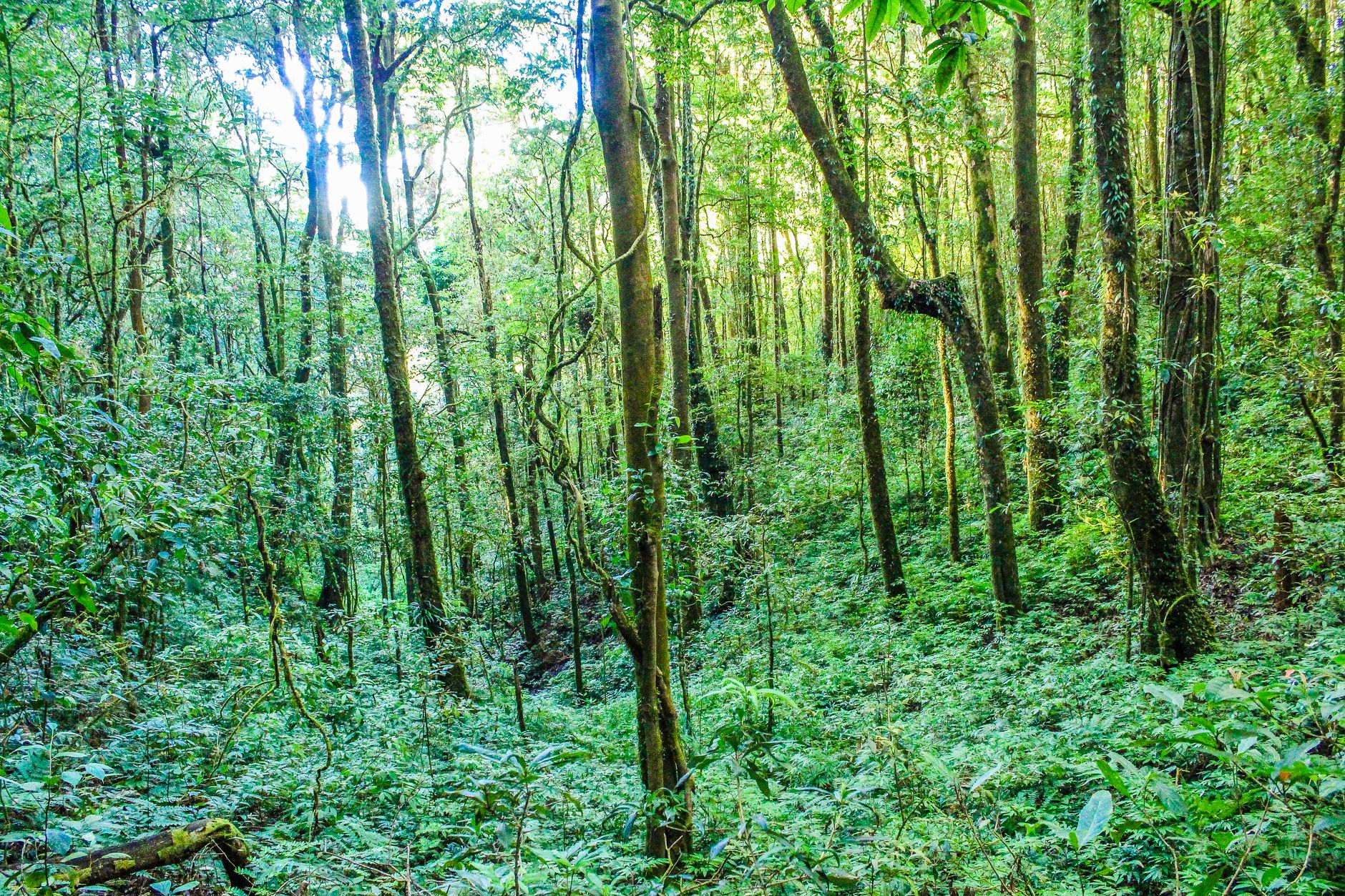
Most of this diversity is concentrated in the humid eastern rainforests, which form a green spine down the wet side of the island. These forests are warm, wet and structurally complex — exactly the conditions frogs love — and they hold the lion’s share of the species, including nearly all the showpieces a traveller hopes to see.
The Main Groups of Madagascar Frogs
You don’t need to be a herpetologist to make sense of Madagascar’s frogs. A handful of major groups account for most of what you’ll meet, and learning them turns a confusing chorus into a cast of recognisable characters. For a deeper field-guide breakdown of each group, see our companion guide to the types of frogs in Madagascar.
The Mantellas — Jewels of the Forest Floor
If Madagascar’s frogs have a celebrity, it is the mantella. These are small frogs — most would sit comfortably on a coin — and they are coloured like enamelled jewellery: vivid orange, blazing gold, emerald green and black, fire-red, or striking patterns of yellow on a dark ground. Unlike most frogs, mantellas are active by day, hopping conspicuously across the leaf litter near forest streams. They can afford to be bold because they are toxic: their skin carries alkaloid compounds that make them distasteful or dangerous to predators, and their bright colours are an honest advertisement of that defence. The golden mantella, a tiny flame-orange frog from a small area of the eastern forests, is the best-known of the group and a conservation icon.
The Tree Frogs (Boophis) — Voices of the Night
If the mantellas own the day, the genus Boophis owns the night. These are the classic tree frogs of the rainforest — slim-bodied, often green or brown or translucent, frequently with jewel-coloured eyes, and equipped with adhesive toe-pads for climbing wet vegetation. Boophis is one of the largest and most varied frog groups on the island, with a great many species, and it is their voices that dominate the rainforest chorus after rain. Some are loud and bell-like, others are soft clicking calls easily mistaken for insects. On a good wet-season night walk you may see a dozen species of Boophis perched on leaves above a forest stream, eyes glowing in your torchlight.
The Tomato Frogs — Plump and Improbably Red
Few frogs anywhere look as photogenic as a tomato frog. Belonging to the genus Dyscophus and native to the humid northeast around Maroantsetra, these are round, plump, ground-dwelling frogs in shades of vivid orange-red — the females especially, which are larger and redder than the males. When threatened, a tomato frog can puff itself up and secrete a sticky, irritating substance, a defence rather than a true toxin. They are a bucket-list animal for many frog-loving travellers, though seeing one in the wild takes some luck and the right region.
The Burrowing and Narrow-Mouthed Frogs
Beyond the showpieces lies a great deal of quieter diversity. Madagascar has a range of burrowing and narrow-mouthed frogs — squat, often secretive animals adapted to spend dry periods underground and emerge to breed when the rains arrive. Some live in the seasonally dry west and the spiny forests of the south, places where surface water is scarce for much of the year. Their explosive breeding choruses, triggered by the first heavy rains, can transform a temporary pool into a frenzy of calling almost overnight.
The Others — A Cast of Hundreds
Then there is the long tail of the island’s frog fauna: stream frogs of the cool highlands, leaf-litter frogs barely larger than a grain of rice, frogs whose tadpoles develop in tree-holes or even on land, and a steady stream of species so newly recognised they barely have common names yet. This is the part of the fauna that keeps growing every year as scientists describe more of it. For the traveller, the practical takeaway is simple: no matter how many frogs you see on a night walk, you are seeing only a fraction of what is out there.
The Mantella Story: Convergent Evolution
The mantellas deserve a closer look, because they are one of the most celebrated examples of convergent evolution in the animal kingdom. To anyone who knows the rainforests of Central and South America, a mantella looks instantly familiar — small, brilliantly coloured, day-active and toxic. It looks, in short, like a poison-dart frog.
And yet mantellas and poison-dart frogs are not closely related at all. They belong to entirely different frog families on opposite sides of the planet, separated by oceans and tens of millions of years of independent evolution. What they share is a way of life. Both groups gave up the frog’s usual strategy of hiding and being nocturnal, and instead became toxic and conspicuously coloured, advertising their defence to predators in broad daylight. Because the same evolutionary problem — how to be a small, ground-dwelling rainforest frog that doesn’t get eaten — produced the same solution twice, independently, on different continents, the two groups ended up looking and behaving like near-twins despite their distant kinship.
It is a textbook case, and standing in a Malagasy forest watching an orange mantella hop boldly across the leaves in daylight, it is worth remembering that the strikingly similar frog a birder might photograph in Costa Rica is, in evolutionary terms, a complete stranger. Convergence like this is one of the most satisfying ideas in natural history, and Madagascar offers a front-row seat.
Where to See Frogs in Madagascar
Frogs are everywhere the forest is wet, but a handful of eastern rainforest parks deliver the best combination of accessibility, diversity and good guiding. These are the strongholds of Madagascar’s amphibian life, and most are part of any serious wildlife itinerary. Our companion guide to where to see frogs in Madagascar goes park by park in detail.
Andasibe-Mantadia
The single most accessible rainforest from the capital, Andasibe-Mantadia is where most travellers get their first taste of Madagascar’s amphibians. Its trails and forest streams are alive with Boophis tree frogs and mantellas, and the after-dark soundscape is famous. Because it sits a manageable drive east of Antananarivo, it is ideal for a first night walk. We cover the wider region in our guide to eastern Madagascar and Andasibe.
Ranomafana
Set in the misty mid-altitude rainforest of the southeast, Ranomafana is a frog paradise. Its streams and steep, dripping slopes hold a remarkable density and variety of species, and its night walks are consistently rewarding. For many wildlife travellers, Ranomafana is the frog highlight of a classic Route Nationale 7 trip.
Masoala and Marojejy
For the committed, the wild northeast holds the richest prizes. Masoala — Madagascar’s largest protected rainforest, running down to the sea — and the rugged mountain forest of Marojejy are wetter, wilder and harder to reach, and they reward the effort with exceptional amphibian diversity, including species found in few other places. The region around Maroantsetra is also the home of the tomato frogs. These parks suit travellers willing to trade comfort for genuine wilderness.
All of these parks feature in our overview of the best national parks and reserves in Madagascar, and a frog-focused trip slots neatly into a broader Madagascar wildlife safari.
When to See Frogs: The Wet Season
Here is the single most important timing fact in this guide, and it runs against the grain of most Madagascar wildlife advice. Frogs are most active, most visible and most vocal in the warm, wet season — roughly November to March. This is when the rains arrive, the streams swell, the humidity climbs, and frogs across the island breed and call. A wet-season night walk can deliver dozens of species; the same trail in the dry depths of the year may be comparatively quiet.
That matters because the conventional wisdom for visiting Madagascar — and for seeing lemurs, hiking and beach time — leans toward the cooler, drier months from around April to October, when roads are better and rainforest treks are more comfortable. Frogs invert that logic. If amphibians are your priority, you want the warm wet months, accepting the trade-off of rain, mud, leeches in places and tougher travel conditions. Many wildlife travellers compromise around the shoulder of the wet season, when frog activity is already high but conditions haven’t yet peaked. Plan the timing carefully using our guide to the best time to visit Madagascar, and weave it into your broader Madagascar itinerary.
How You’ll See Them: Night Walks
Frogs are, above all, a night-walk animal. After dark, with a head torch and a knowledgeable local guide, the rainforest becomes a different world. Eyes shine back from the leaves, calls help guide you to hidden singers, and the frogs — many of which sit motionless and confiding once found — let you watch and photograph them at close range. A good guide is essential and transformative: they know the calls, the favoured perches, the difference between a leaf and a leaf-mimicking frog, and they will find in minutes what you might miss in an hour alone.
Night walks are usually done just outside park boundaries or on designated night trails, and they are short, gentle and accessible to most fitness levels — the reward-to-effort ratio is excellent. The best are unhurried, with a guide who lets you linger on each find. You can browse guided wildlife and night-walk tours on GetYourGuide, or have a fully tailored rainforest itinerary built for you — more on that below.
Conservation: Frogs Under Threat
Madagascar’s frogs face serious and overlapping pressures, and an honest guide has to name them. The greatest is habitat loss. The eastern rainforests that hold most of the island’s amphibian diversity have been heavily reduced and fragmented by clearing for agriculture, logging and fire, and because so many frog species have tiny ranges, the loss of even a single valley of forest can imperil species found nowhere else.
The second great threat is the chytrid fungus — a pathogen that has devastated amphibian populations across other continents and driven species to extinction elsewhere in the world. The fungus has been detected in Madagascar, and conservationists regard it as a looming catastrophe for a frog fauna that evolved in isolation and may have little resistance. Monitoring and biosecurity efforts are ongoing, but the risk is real and taken extremely seriously.
A third pressure falls especially on the mantellas: the international pet trade. Their jewel-like colours make them prized by collectors, and wild collection has historically added to the strain on already small, fragmented populations. Captive-breeding programmes and trade controls aim to relieve this, but it remains a concern for the most sought-after species.
The encouraging side of the story is that responsible wildlife tourism is part of the solution. Park fees, guide employment and the income that flows to forest-edge communities give Madagascar’s rainforests a living value, strengthening the case for keeping them standing. Travelling to see the frogs, with reputable guides and protected-area support, is a genuine contribution to their survival.
How to Plan a Frog and Amphibian Trip
A frog-focused trip to Madagascar comes down to three decisions: where, when, and how it’s organised. The where is the eastern rainforests — most often a combination of accessible Andasibe and richer Ranomafana, with the wild northeast (Masoala, Marojejy, Maroantsetra) for those with more time and appetite for adventure. The when is the warm wet season, November to March, or its shoulders. And the how is where a local specialist earns their keep: connecting the dots between parks, arranging the right night-walk guides, and timing everything to the rains.
For the practicalities, our companion guides cover Madagascar frog tour packages and what a trip actually costs. As a rule, a dedicated amphibian trip costs broadly the same as any rainforest wildlife trip — the spend is on transport between distant parks, quality guiding and comfortable lodges, rather than on the frogs themselves. The biggest single lever on cost is how remote you go: Andasibe and Ranomafana are relatively economical, while the deep northeast adds charter flights, boats and time. Many travellers find the best value in a private trip with a car and driver, which keeps the itinerary flexible enough to chase the rain. You can arrange a car and driver through Carla and base yourself in lodges near the parks on Agoda.
Photographing Frogs
Frog photography in Madagascar is rewarding but demanding, because nearly all of it happens at night, at close range, in difficult light. A macro lens is the single most useful piece of kit — many of these animals are tiny, and the magic is in the detail of an eye, a toe-pad or a translucent flank. You’ll need a reliable torch or, better, a small off-camera light to give soft, directional illumination rather than a flat on-camera flash. Patience matters: let your guide find the frog, approach slowly, and take your time, because a confiding tree frog will often sit beautifully if you don’t rush it.
Steady support helps in the low light, and learning to focus manually in the dark pays off quickly. Above all, photograph with care for the animal — minimal handling, no harsh repeated flashing, and respect for the guide’s lead. For lenses, settings and a wider look at shooting Madagascar’s wildlife, see our guide to Madagascar wildlife photography.
Getting There and Travelling Well
Reaching Madagascar means an international flight into Antananarivo, almost always routed through a European or regional hub, followed by domestic travel east to the rainforests. Long-haul journeys with connections carry a real risk of delays and cancellations, so it pays to be protected. If your inbound flight is routed through Europe and is delayed, cancelled or overbooked, you may be entitled to compensation of up to €600 per passenger under EU261 — a claims service like AirAdvisor can pursue it on your behalf. Note that EU261 applies only to the European-routed international leg, not to Madagascar’s domestic flights.
Equally important is proper travel insurance. Rainforest trips involve remote areas, night walks, rough roads and the ordinary risks of travel far from major hospitals, so comprehensive cover is not optional. SafetyWing Nomad Insurance is a flexible, traveller-friendly option that suits the kind of multi-region, outdoor itinerary a frog trip involves. Arrange your SafetyWing cover before you fly, and travel knowing the wilder, wetter parts of your trip are accounted for.
Plan It With Carla, a Resident Specialist
Timing a frog trip to the rains, lining up the right night-walk guides and stitching together distant rainforest parks is exactly the kind of planning that benefits from local knowledge. Carla, our resident Madagascar specialist, builds tailored rainforest itineraries with the night walks and wet-season timing that bring the frogs to life — and arranges the car, driver and lodges to match. Rather than piecing it together from afar, reach out to Carla to design a trip around exactly the amphibians and forests you want to see. She can also fold in a SafetyWing recommendation and the right transfers.
Frequently Asked Questions
How many frog species does Madagascar have?
More than 300 frog species have been formally described, and scientists agree many more are still undescribed, so the true total is higher and still climbing. Around 99% of them are endemic — found only in Madagascar.
Does Madagascar really have no toads or salamanders?
Correct — Madagascar’s native amphibian fauna is made up entirely of frogs. There are no native toads, newts or salamanders. The only toad you might see is the introduced Asian common toad, a recent and unwelcome arrival in the east, not a native species.
What is the best time of year to see frogs in Madagascar?
The warm, wet season, roughly November to March, when frogs breed and call most actively. This is the opposite of the dry-season timing usually recommended for general Madagascar travel, so it’s a deliberate trade-off if amphibians are your priority.
Are mantellas the same as poison-dart frogs?
No — they only look alike. Mantellas and South American poison-dart frogs belong to completely different families and evolved their bright colours, daytime habits and toxicity independently. It’s a famous example of convergent evolution.
Where is the easiest place to see frogs?
Andasibe-Mantadia, an accessible rainforest a manageable drive east of Antananarivo, is the usual first stop. Ranomafana, on the classic Route Nationale 7 route, is the other great frog destination. A guided night walk in either is the surest way to see them.
🐸 Plan a Frog & Wildlife Trip — Ask Carla
Get a rainforest trip with the night walks and wet-season timing that bring Madagascar’s frogs to life, by a resident specialist. Reach out to Carla.
Plan Your Trip to Madagascar
- Read the full Madagascar Travel Guide
- Explore itineraries by style and duration
- Explore the full destination guide
Where to Stay