The Traveller’s Palm: Madagascar’s Natural Compass That Isn’t
This article contains affiliate links. We may earn a small commission at no extra cost to you if you book through them.
By Jordan Lamont · Last updated 6 October 2026
At a Glance
- What it is: the traveller’s palm (Ravenala madagascariensis), a national emblem of Madagascar
- Not a palm: it belongs to the bird-of-paradise family (Strelitziaceae)
- Size: usually ~7 m; the “Bemavo” form can reach 30 m
- The myth: it is not a reliable natural compass
- Pollinator: ruffed lemurs — a rare plant-and-primate partnership
Say it like a local: Ravenala (rah-vuh-NAH-lah); from the Malagasy ravinala, “forest leaves.”
You have seen it before you ever set foot in Madagascar — on the tail of the national airline, on banknotes, on the badge of the country itself. The traveller’s palm, with its enormous flat fan of leaves splayed against the sky, is the single most recognisable plant on the island. Almost everything most people “know” about it is wrong. It is not a palm, it is not a reliable compass, and the way it reproduces is stranger than any of the tourist legends. Here is the real plant behind the emblem.
The compass that isn’t
The most repeated story is that the traveller’s palm aligns its great fan on an east–west axis, so a lost traveller could read it like a natural compass. It is a lovely idea, and it is one plausible origin of the name. It is also not something you should bet your life on. The fan does tend toward an east–west line — most likely to catch the low morning and evening sun while sparing the leaves the worst of the midday heat — but the orientation is loose, and individual plants cheerfully grow whichever way they please. Botanists who have watched them for years say the same thing: admire the fan, but pack an actual compass.
The real reason it’s called the traveller’s palm
The better explanation is hidden at the base of the leaves. Where each long stalk meets the trunk, it forms a cupped sheath that catches and holds rainwater — sometimes a litre or more, sealed away from the sun. The old story goes that a traveller dying of thirst could pierce the base and drink. “Supposedly” is the operative word: the water is often stagnant and full of insects and debris, so treat this strictly as folklore rather than survival advice. But it is almost certainly where the name comes from — a plant that quietly carries water for whoever passes.
It isn’t a palm at all
Here is the fact that surprises almost everyone: the traveller’s palm is not a palm. It belongs to the Strelitziaceae — the same small family as the bird-of-paradise flowers you see in florists’ bouquets. Look closely and the family resemblance is obvious: the same fan-like architecture, the same bold geometric flowers. A typical plant stands around seven metres, but the giant “Bemavo” form can tower to thirty — a bird of paradise the size of a tree. For most of its history it was treated as the only species in its genus, a true one-of-a-kind endemic found naturally nowhere on Earth but Madagascar.
The lemur that plants the next generation
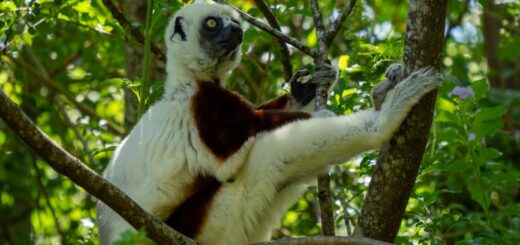
The strangest chapter is how it breeds. The traveller’s palm’s tough, cream-coloured flowers are too big and sturdy for most pollinators to bother with — so the job falls to a primate. Ruffed lemurs are a known pollinator: they pull the flowers open with their hands to reach the nectar, and in doing so coat their faces and fur in pollen that they carry to the next plant. It is one of the few plant-and-primate pollination partnerships anywhere in the world, thought to have coevolved over millions of years. The same lemurs that draw visitors to Madagascar’s forests are, quietly, the island’s gardeners.
Why it matters today
The traveller’s palm earned its place on the flag-tail and the banknote honestly: it is endemic, unmistakable, useful, and bound up with the island’s most famous animals. It also stands as a neat lesson for any visitor — that the easy tourist story (a compass! free water!) is usually less interesting than the truth (a bird-of-paradise relative, pollinated by lemurs, that merely leans toward the sun). You will see it the moment you land and for the rest of your trip. Plan when to go, and read the rest of our Madagascar travel guide to meet the island on its own terms.
FAQ
Does the traveller’s palm really point east–west?
Its giant fan often grows roughly on an east–west line, but it is not reliable enough to use as a compass — individuals grow in different directions. Pack a real compass.
Is the traveller’s palm actually a palm?
No. Despite the name it is not a palm at all — it belongs to the Strelitziaceae, the bird-of-paradise family.
Can you really drink the water it holds?
The leaf bases trap rainwater, and tradition says thirsty travellers could drink it — hence the name. Treat it as folklore, not a safe water source.
Where can you see it in Madagascar?
It grows across the humid east and is planted nationwide; it is a national emblem you will see almost everywhere you travel.
Travel insurance for Madagascar
Medical evacuation from Madagascar’s interior can cost USD 30,000–80,000, so travel medical cover is worth arranging before you go. SafetyWing is the disclosed partner we mention on this site — a monthly-subscription travel medical plan. Check SafetyWing’s plans.
Plan Your Trip to Madagascar
- Read the full Madagascar Travel Guide
- Explore itineraries by style and duration
- Explore the full destination guide
Where to Stay