Things to Do at Tsingy de Bemaraha 2026: Via Ferrata, Manambolo & Wildlife
Affiliate disclosure: This article contains sponsored links to hotels, tour operators, insurance providers, and other travel services. We earn a small commission if you book through our links, at no extra cost to you.
Things to Do at Tsingy de Bemaraha 2026 — At a Glance
- Top experiences: climb the Grand Tsingy via ferrata to the high suspension bridge, walk the gentler Petit Tsingy, paddle the Manambolo River gorge by pirogue, and spot Decken’s sifaka and lemurs on shaded nature trails.
- Best time: the dry season, roughly April to November — the park is closed and the access tracks are impassable in the wet months.
- Guided tours: browse guided tsingy tours on GetYourGuide to lock in your circuits in advance.
- Plan with a local: contact Carla to match the right circuits to your fitness and time.
- Car & driver: the road in is rough — arrange a car & driver via Carla rather than self-driving.
- Flight delays? If a connection to Madagascar is delayed or cancelled, you may be owed compensation — check with AirAdvisor.
- Travel insurance: for a rugged park far from hospitals, carry SafetyWing Nomad Insurance.
- Where to stay: compare Madagascar stays on Agoda around Bekopaka and Morondava.
- Want a longer expedition? See our dedicated Tsingy de Bemaraha trekking guide for multi-day routes.
🐿 Wildlife-Watching Gear for Madagascar
The right kit turns a good wildlife trip into a great one:
- 8×42 binoculars — essential for spotting lemurs and chameleons in the canopy. See on Amazon →
- Rechargeable headlamp — essential for night walks; red mode won’t disturb wildlife. See on Amazon →
- Trekking poles — ultralight support for long park hikes. See on Amazon →
- Hiking daypack — comfortable pack for water, camera and layers. See on Amazon →
- Picaridin insect repellent — DEET-free protection against malaria mosquitoes. See on Amazon →
As an Amazon Associate we earn from qualifying purchases.
Tsingy de Bemaraha is one of those places that does not really have a comparison anywhere else on Earth. A vast forest of razor-edged grey limestone needles rising out of the dry western Madagascar landscape, the park is a UNESCO World Heritage Site and a strict nature reserve, and it rewards travellers who are willing to make the long, bumpy journey to reach it. What makes it special is not just the surreal scenery but the sheer variety of things you can actually do here — this is not a place you simply look at from a viewpoint. You climb it, you crawl through it, you paddle past it, and you walk through forests that hide animals found nowhere else on the planet.
This guide breaks down exactly what you can do once you are inside the park: the headline Grand Tsingy circuit with its via ferrata cables and famous suspension bridge, the gentler Petit Tsingy for those wanting less exposure, the Manambolo River gorge by pirogue, the wildlife walks, the easy nature trails, the photography, and the multi-day trek option for those who want a real expedition. It also covers the practical side — what to wear, what to bring, and how the compulsory guide system works — so you arrive knowing what to expect from each experience.
The Grand Tsingy — the headline adventure
The Grand Tsingy is the experience most people travel all this way for, and it lives up to the reputation. This is the dramatic, full-bodied circuit that takes you up and into the heart of the limestone forest, where blades of grey rock rise dozens of metres above the trail and the gaps between them drop away into dark, narrow chasms. The route is a genuine adventure: you scramble over boulders, squeeze through slot-like crevices, climb fixed metal ladders bolted into the rock, and clip onto fixed steel cables — a via ferrata system — to move safely across the most exposed sections. Your guide fits you with a harness at the start and shows you how to clip in, and from there it is a combination of careful footwork and a bit of upper-body effort.
The reward at the top is one of the great views in Madagascar. From the highest viewpoints you look out over an endless sea of grey pinnacles stretching to the horizon, with the green canopy of the surrounding forest threaded between them. The single most famous moment of the Grand Tsingy is the high suspension bridge — a narrow, swaying span strung between two rock towers high above the forest floor. Crossing it is exhilarating, a little nerve-testing, and the photo opportunity that ends up on most people’s wall when they get home. The full Grand Tsingy circuit typically takes several hours and demands a reasonable level of fitness, but the sense of accomplishment when you finish is enormous. If the Grand Tsingy is on your list, it helps to plan ahead — our complete Tsingy de Bemaraha guide covers how the circuits fit together across a typical visit.
The Petit Tsingy — the gentler option
Not everyone wants — or needs — the full exposure of the Grand Tsingy, and that is exactly what the Petit Tsingy is for. As the name suggests, this is the smaller, gentler version of the experience: a shorter circuit closer to Bekopaka with far less height, fewer technical sections, and a much more relaxed pace. You still walk among the iconic limestone formations, still get to appreciate the strange beauty of the rock up close, and still see the way water and time have carved the stone into knife-edged ridges — but without the long via ferrata climbs and the high suspension bridge.
The Petit Tsingy is ideal for travellers with limited time, families with children, anyone unsure about heights, or visitors who want a taste of the tsingy without committing to a strenuous half-day climb. Many people actually do both: a morning on the Petit Tsingy to ease into the terrain and understand what they are looking at, followed by the Grand Tsingy the next day once they are warmed up and confident. Because it is less demanding, the Petit Tsingy also leaves more energy for the Manambolo River trip or a wildlife walk. It is a reminder that Tsingy de Bemaraha is not an all-or-nothing destination — there is a way to experience it for almost every level of ability.
What the via ferrata is actually like
The phrase “via ferrata” can sound intimidating if you have never done one, so it is worth explaining what it really involves at Tsingy de Bemaraha. A via ferrata is a protected climbing route: fixed steel cables and metal rungs are permanently anchored into the rock, and you wear a harness with a lanyard that clips onto the cable. As long as you stay clipped in, you are secured to the mountain even on the most exposed sections. The gear — harness, lanyard and carabiners, and a helmet where needed — is provided as part of the guided visit, and your guide demonstrates exactly how to use it before you start.
In practical terms, expect a mix of walking, scrambling over rock, climbing ladders, and edging along ledges with the cable always at hand. There are real heights involved and some sections are genuinely exposed, so a head for heights helps and a reasonable level of fitness is needed — you will be using your arms and legs and there is some squeezing through tight gaps. That said, you do not need to be a trained climber. Thousands of ordinary travellers complete the Grand Tsingy every dry season. The honest caveat is that it is not suitable for anyone with severe vertigo or significant mobility limitations, and the via ferrata sections cannot be skipped on the Grand circuit. If that describes you, the Petit Tsingy or the nature trails are the right choice, and your guide will help you pick. Going with a well-organised guided tsingy tour means the safety gear and the briefing are all handled for you.
The Manambolo River gorge by pirogue
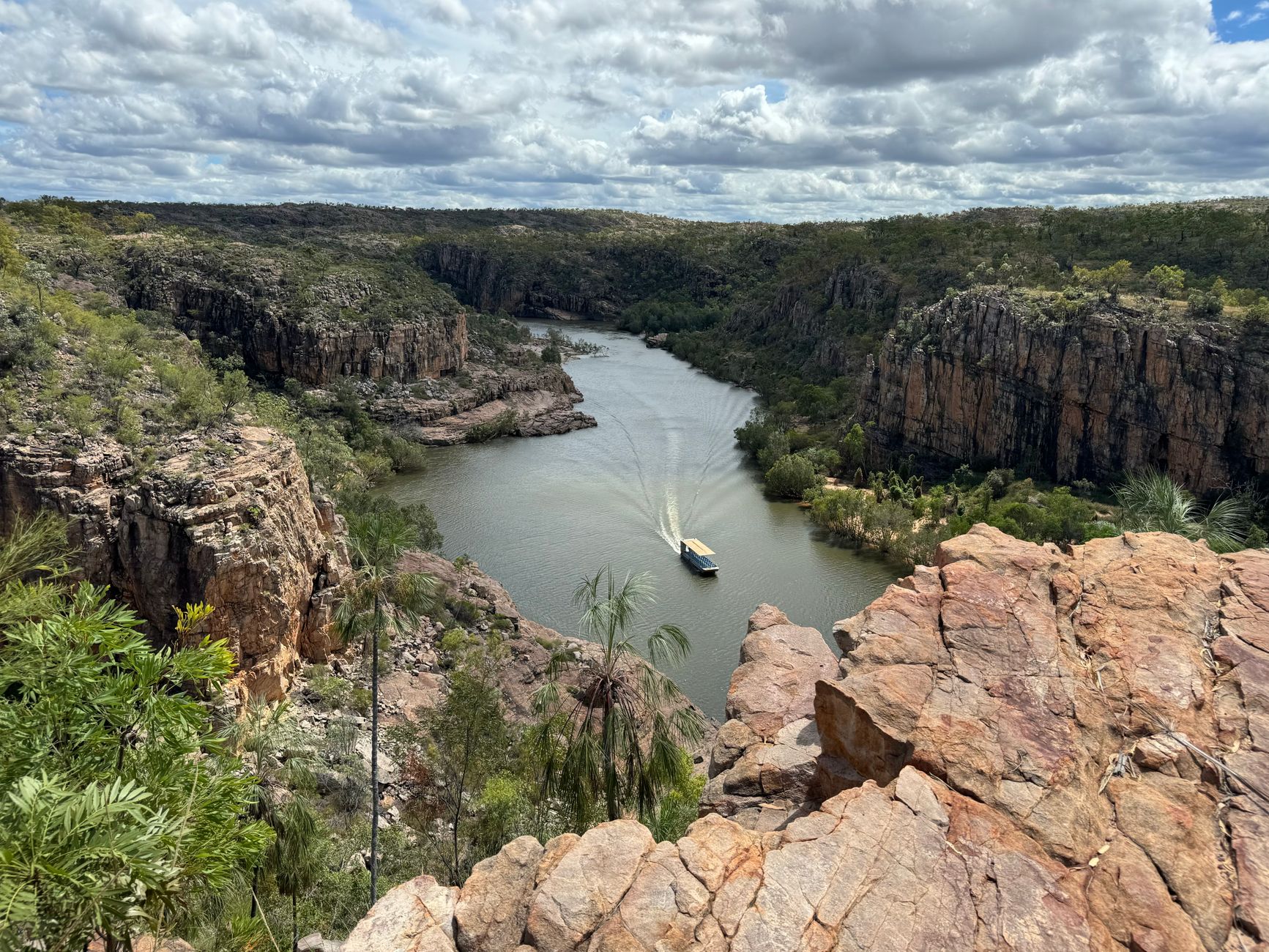
One of the most atmospheric — and most relaxed — things to do at Tsingy de Bemaraha has nothing to do with climbing at all. The Manambolo River cuts a deep gorge through the limestone, and a slow trip along it by pirogue (a traditional dugout canoe) is a completely different way to experience the landscape. Gliding along the calm water, you look up at sheer cliff walls hundreds of feet high, with the strange tsingy formations crowning the rim above you. It is quiet, shaded, and a welcome contrast to the heat and exertion of the rock circuits.
The gorge is also a place of deep cultural significance. The cliffs are dotted with caves, and tucked into ledges and openings in the rock you can see ancestral burial sites — tombs associated with the Vazimba, often considered the earliest inhabitants of the region, and with the local Antandroy people. Your guide will explain the customs and beliefs surrounding these sacred places, and it is important to treat them with respect. Some pirogue trips also stop at caves where you can step ashore and explore. The Manambolo gorge is a beautiful, restful, and culturally rich half-day that pairs perfectly with a morning of climbing — and it is one of the experiences that makes Tsingy de Bemaraha feel like so much more than a rock-climbing destination.
Wildlife walks — lemurs, birds and reptiles
Tsingy de Bemaraha is a serious wildlife destination, and the forests around and within the tsingy shelter species you will struggle to see anywhere else. The star attraction is the Decken’s sifaka, a striking white lemur that leaps and bounds between the rocks and trees with astonishing agility — watching one cross a chasm in a single leap is unforgettable. You also have a good chance of seeing red-fronted brown lemurs moving through the canopy in groups during the day. On a guided night walk, the forest comes alive with nocturnal lemurs, their eyes shining in the torchlight, along with a host of other creatures that only emerge after dark.
Beyond the lemurs, the park is rich in birds, reptiles and endemic plants. Birdwatchers can hope for a variety of forest and dry-country species, while the rocks and undergrowth hide chameleons, geckos and other reptiles that have adapted to this unusual habitat. The plant life is remarkable too, with hardy, drought-tolerant species clinging to the bare limestone and sheltering in the cooler crevices. A wildlife-focused walk is often gentler than the climbing circuits, making it accessible to a wide range of visitors. If wildlife is your main reason for travelling to Madagascar, it is worth seeing how Tsingy fits into the wider picture — our guide to the best national parks and reserves shows how it compares with the country’s other great wildlife sites.
Easier nature trails for non-climbers
If the idea of harnesses and suspension bridges is not for you, do not write off Tsingy de Bemaraha — there is plenty here for non-climbers. In addition to the Petit Tsingy, the park has gentler nature trails that wind through the forest at the base of the formations, giving you a real sense of the landscape and its wildlife without any technical climbing. These walks are shaded, scenic, and far less strenuous, and they are an excellent way to enjoy the place at a slower pace while still getting close to the rock.
These easier options make Tsingy de Bemaraha far more inclusive than its dramatic reputation suggests. Travellers who prefer a calmer day, those carrying a minor injury, families with younger children, and anyone simply wanting to soak up the atmosphere can all have a rewarding visit. Combined with the Manambolo River trip, a couple of gentle nature walks can fill a memorable day or two without ever clipping onto a cable. When you talk through your plans, your guide — or Carla, if you book through us — can put together a programme that keeps the experience comfortable while still showing you the best of the park.
Photography at Tsingy de Bemaraha
Few landscapes in the world are as photogenic as the tsingy, and the park is a dream for keen photographers. The forest of grey pinnacles changes character through the day: the low light of early morning and late afternoon rakes across the rock, picking out the texture and casting long shadows down into the chasms, while the midday sun flattens everything into a harsher, brighter scene. For the best results, aim to be at the high viewpoints when the light is soft, and bring a wide-angle lens to capture the scale of the pinnacle fields and a longer lens for the lemurs and birds.
Practical photography at Tsingy comes with a few realities. The terrain is rough and your hands are often busy on the cables, so a secure strap and a way to stash your camera while climbing are essential — many people prefer a compact camera or phone for the via ferrata sections and save the bigger kit for the viewpoints and nature trails. Dust is a factor in the dry season, so protect your gear, and remember that the very best photographic moments, like the suspension bridge, demand a moment of calm rather than a rushed snap. The Manambolo gorge, with its towering cliffs and reflections on the water, offers a completely different and equally rewarding set of images.
The multi-day trek option
For travellers who want more than a day or two of circuits, Tsingy de Bemaraha can be experienced as a genuine multi-day trek — a longer expedition that goes deeper into the reserve, links several circuits, and lets you immerse yourself in the landscape over consecutive days. A trek means more time on the trail, more remote sections, camping or staying in basic accommodation, and a far greater sense of wilderness than a day visit allows. It is demanding and not for everyone, but for the right traveller it is one of the most rewarding adventures Madagascar has to offer.
Because trekking here involves serious logistics — guides, porters, supplies, permits and careful timing within the dry season — it deserves its own dedicated planning. If a longer expedition appeals to you, read our full Tsingy de Bemaraha trekking guide, which covers routes, difficulty, what to pack, and how to arrange a multi-day trip. It is also worth looking at how the trek slots into a broader western Madagascar itinerary alongside the iconic Avenue of the Baobabs, which most travellers visit on the same journey to or from Morondava.
Practical tips for visiting
The single most important piece of practical advice concerns your footwear. The tsingy rock is genuinely sharp — these are not rounded boulders but knife-edged blades of limestone — so sturdy closed shoes with good grip are non-negotiable. Sandals or worn-out trainers are a recipe for cuts and slips. Many guides recommend gloves to protect your hands when you grip the rock, and they are well worth bringing. Carry plenty of water, because the dry-season heat is significant and there is no shop inside the park, and pack proper sun protection — hat, sunglasses and sunscreen — as much of the climbing is exposed to full sun.
Timing matters enormously. The park is only open and accessible during the dry season; in the wet months the access tracks become impassable and the reserve closes, so plan your trip accordingly — our guide to the best time to visit Madagascar explains the seasons in detail. Finally, a Madagascar National Parks (MNP) guide is compulsory for every circuit; you cannot enter the tsingy alone. The guides are knowledgeable, manage the safety equipment, and are part of what makes the experience so good, so factor a guide fee into your budget. For a sense of the wider expenses, our Tsingy de Bemaraha trip cost guide breaks down what a visit typically involves, and our tour packages overview shows how everything can be bundled together.
Safety at Tsingy de Bemaraha
The via ferrata system is well established and the compulsory guides are trained to manage it, so the climbing is safe when you follow instructions and stay clipped in. Listen carefully to your guide’s briefing, keep your harness and lanyard properly attached on exposed sections, and never rush. The bigger risks are the everyday ones: dehydration, sunstroke, slips on sharp rock, and the long rough drive to reach the park. Be honest with yourself and your guide about your fitness and comfort with heights so you choose the right circuit. The park is remote and far from any major hospital, which is exactly why proper travel insurance is essential for a visit here.
Getting There & Travelling Well
Reaching Tsingy de Bemaraha is part of the adventure: most travellers fly into Madagascar via Antananarivo, then continue to Morondava before tackling the rough overland route to Bekopaka. With multiple connections in play, delays happen — if your flight to Madagascar is delayed or cancelled, you may be entitled to compensation, and AirAdvisor can check your claim and handle it for you.
Because the park is genuinely remote — far from hospitals, on rough tracks, and involving physical activity at height — travel insurance is not optional here. SafetyWing Nomad Insurance is a flexible, affordable option that covers medical care and travel disruption, which matters when you are days from a major town. Take a moment to set up SafetyWing before you travel so you can focus on the climbing, the river and the wildlife with real peace of mind.
Plan your Tsingy adventure with Carla
Tsingy de Bemaraha rewards good planning, and that is where a local expert makes all the difference. Carla can match the right mix of circuits — Grand, Petit, Manambolo and wildlife walks — to your fitness, time and comfort with heights, and arrange a reliable car & driver via Carla for the demanding road in. To build a trip that flows smoothly from Morondava to the tsingy and back, contact Carla and tell her what kind of experience you are after.
Frequently Asked Questions
What is the difference between the Grand Tsingy and the Petit Tsingy?
The Grand Tsingy is the headline circuit: a longer, more demanding route with via ferrata cables, ladders, tight crevices and the famous high suspension bridge, reaching the highest and most dramatic viewpoints. The Petit Tsingy is smaller, gentler and closer to Bekopaka, with far less height and exposure — ideal for those short on time, less confident with heights, or wanting an easier introduction. Many visitors do both, starting with the Petit Tsingy and progressing to the Grand.
Is the via ferrata scary or hard?
There are real heights and some exposed sections, so it can feel daunting if you are nervous about heights — but you are clipped onto fixed steel cables the whole time and the gear is provided. With a clear guide briefing and careful footwork, most ordinary travellers complete it successfully. It is not suitable for anyone with severe vertigo or significant mobility limitations, in which case the Petit Tsingy or the nature trails are the better choice.
Do I need to be fit to visit?
For the Grand Tsingy, a reasonable level of fitness helps — you will be scrambling over rock, climbing ladders and using your arms and legs over several hours. You do not need to be an athlete or a trained climber, but you should be comfortable with sustained physical effort. For the Petit Tsingy, the Manambolo River trip and the easier nature trails, much lower fitness is required, so there is a suitable option for almost everyone.
What should I wear?
Sturdy closed shoes with good grip are essential — the tsingy rock is razor-sharp, so sandals and worn trainers are unsafe. Wear lightweight, breathable clothing that allows movement, and bring gloves to protect your hands on the rock. Add a hat, sunglasses, sunscreen and plenty of water, as much of the climbing is exposed to full sun and there are no shops inside the park.
Can non-climbers visit Tsingy de Bemaraha?
Absolutely. Non-climbers can enjoy the Petit Tsingy, the gentle nature trails, the Manambolo River pirogue trip and wildlife walks, all of which avoid the via ferrata and the suspension bridge. With a good guide, you can build a full, rewarding visit without any technical climbing at all, so the park is genuinely accessible to a wide range of travellers.
Ready to explore Tsingy de Bemaraha?
From the via ferrata of the Grand Tsingy to a quiet pirogue down the Manambolo, the right plan makes this remote park unforgettable. Let Carla tailor your circuits, sort the logistics and arrange your transport so you can focus on the adventure.
Plan Your Trip to Madagascar
- Read the full Madagascar Travel Guide
- Explore itineraries by style and duration
- Best Tours and Guided Experiences
Where to Stay