Why Lemurs Exist Only in Madagascar
This article contains affiliate links. We may earn a small commission at no extra cost to you if you book through them.
By Jordan Lamont · Last updated 10 October 2026
At a Glance
- How they arrived: rafted from Africa ~50+ million years ago
- Why they thrived: an island with no predators or monkeys to compete
- The result: 100+ species, from mouse lemur to indri
- Why nowhere else: monkeys evolved too late to reach or displace them
- See them: Madagascar’s lemur guide · tours
Say it like a local: varika (VAH-rik) / gidro — Malagasy words for lemur.
Lemurs are the face of Madagascar — and they live, in the wild, absolutely nowhere else on Earth. Not in Africa, 400 kilometres away; not anywhere. How did an entire branch of the primate family end up marooned on one island, exploding into a hundred species while vanishing everywhere else? The answer is a tale of a lucky raft, an empty paradise, and perfect timing. (To go and meet them, see our lemur guide; this is the story of why they’re here.)
A voyage by accident
Lemurs did not evolve on Madagascar — their ancestors arrived there. Around 50-plus million years ago, by the best current evidence, a small population of primitive primates made an extraordinary, accidental crossing from mainland Africa, most likely adrift on a raft of matted vegetation swept out to sea by a storm and carried across the Mozambique Channel. It was a one-in-a-million journey — and the castaways that survived it became the founders of every lemur alive today.
An empty paradise
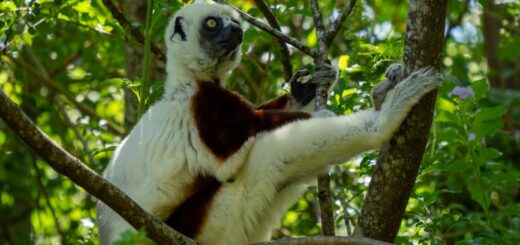
What they found was a predator-light island with countless unfilled ecological roles and no competition from other primates. In those conditions, evolution ran wild. The founders underwent a spectacular adaptive radiation, diversifying into more than 100 species to fill every niche — tiny nocturnal mouse lemurs, leaping sifakas, the singing indri, the bizarre aye-aye. It is one of the textbook examples of what life does when handed an open world.
The monkeys that never came
Here is the crucial twist. On the African mainland, lemur-like primates were later outcompeted and largely replaced by monkeys — smarter, more adaptable haplorhine primates. But monkeys evolved after the lemurs’ ancestors had already rafted to Madagascar and filled the island. Cut off by the sea, the lemurs never had to face that competition, and the monkeys never managed to colonise the island. Madagascar became a lost world where an older kind of primate survived and flourished long after it had faded elsewhere.
Why it matters today
The lemurs are living proof of what isolation can create — and, tragically, how fragile it is. Because they exist nowhere else, the loss of Madagascar’s forests is, for them, the loss of everything; lemurs are among the most endangered mammals on Earth. Understand their origin and you understand the stakes. Pair this with our story of the island’s isolation and the wider wildlife guide, and meet them responsibly via our lemur guide.
FAQ
Why do lemurs live only in Madagascar?
Their ancestors reached the isolated island — probably on rafts of vegetation from Africa about 50+ million years ago — and, with no competitors, evolved into 100+ species found nowhere else.
How did they get there?
By accident: a small founding population likely drifted across the Mozambique Channel on floating mats of vegetation, an “overwater dispersal.”
Why are there no monkeys in Madagascar?
Monkeys evolved after lemurs’ ancestors had already colonised Madagascar and filled its niches, so monkeys never established there — leaving the lemurs unchallenged.
How many lemur species are there?
More than 100, from the mouse lemur to the indri — a textbook case of adaptive radiation.
Travel insurance for Madagascar
Medical evacuation from Madagascar’s interior can cost USD 30,000–80,000, so travel medical cover is worth arranging before you go. SafetyWing is the disclosed partner we mention on this site — a monthly-subscription travel medical plan. Check SafetyWing’s plans.