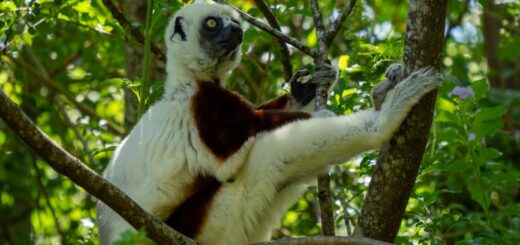
The Aye-Aye: Why Madagascar’s Strangest Lemur Is an Omen of Death
This article contains affiliate links. We may earn a small commission at no extra cost to you if you book through them.
By Jordan Lamont · Last updated 6 October 2026
At a Glance
- What it is: the aye-aye (Daubentonia madagascariensis), the world’s largest nocturnal primate
- Where: eastern rainforests and dry forests of Madagascar
- Status: Endangered (IUCN, 2014) — habitat loss and killing
- The belief: if it points its finger at you, you will die unless it is killed
- Want to see one? How to see an aye-aye — our full guide
Book your Madagascar tours
Madagascar’s best small-group wildlife, lemur and park tours book out months ahead in peak season (July–October). Browse Madagascar tours & check live availability on GetYourGuide →
Say it like a local: aye-aye ≈ “eye-eye”; fady (FAH-dee) = a sacred taboo.
In most of the world, a rare animal is something to protect. In parts of Madagascar, the aye-aye is something to kill on sight — and the people who kill it believe they are saving their own lives. No animal on the island is wrapped in more dread, and few are closer to vanishing because of it. This is the story of how a harmless lemur became the face of death.
The most feared animal on the island
The aye-aye is, by any measure, strange. It is the largest nocturnal primate alive, with rodent-like teeth, huge reflective eyes, bat-like ears, and a skeletal middle finger longer and thinner than the rest. It sleeps by day in a ball of leaves high in the canopy and emerges after dark. For a culture in which the night belongs to spirits and ancestors, an animal seen only at night — staring, pointing a long bony finger — was never going to be read as ordinary.
What the aye-aye actually does with that finger
Here the truth is stranger, and more wonderful, than the legend. The aye-aye’s middle finger is one of evolution’s rarest tools. The animal taps on dead wood up to eight times a second and listens for the echo of a hollow inside — a technique called percussive foraging, found in almost no other mammal. When it hears a grub’s tunnel, it gnaws a hole and threads in that thin finger, which has its own ball-and-socket joint like a tiny shoulder, to hook the larva out. It fills the ecological role a woodpecker plays elsewhere. The finger that legend says marks you for death is, in reality, a feeding instrument of astonishing precision.
The fady: the finger that marks you for death
The belief is specific, and old. In many eastern communities the aye-aye is fady — taboo — and regarded as a harbinger of evil. The core of the superstition is the finger: if an aye-aye points its middle finger at you, you are marked to die, and the only way to lift the curse is to kill the animal. Some villages go further, killing it on sight and hanging the body at the edge of the village or by a road so that passing travellers carry the misfortune away. One account records a belief that aye-ayes creep into houses and kill sleeping people by piercing a vital artery with that finger. Where the fady holds, simply being seen by an aye-aye is a death sentence — for the aye-aye.
The cruel twist: the belief that protects everything else is the one that kills this
This is what makes the aye-aye’s case so bitter. Across Madagascar, fady is usually a conservation force — taboos that forbid hunting a certain lemur, cutting a sacred forest, or fishing a holy lake have protected wildlife for centuries. The aye-aye suffers the one inversion of the rule: a taboo that demands the animal’s death rather than its protection. Layer that onto rainforest loss and you have a species the IUCN moved to Endangered in 2014 — an animal once declared extinct in 1933, rediscovered in 1957, and still fighting a superstition as much as a bulldozer. You can read how fady and custom shape daily life in Madagascar to see how unusual this inversion is.
Not every village agrees
It would be wrong to say “Malagasy people kill the aye-aye.” They don’t, uniformly. Researchers interviewing eastern communities have found attitudes split: roughly half expressed fear or revulsion, while the rest felt fondness or indifference. The fady is strong in some regions and absent in others, and a growing conservation movement — including protected populations such as those on Aye-Aye Island near Mananara — is working with local belief rather than against it. The legend is powerful, but it is not the whole country.
Why it matters today
The aye-aye is a test of whether a culture and a species can renegotiate an old story before it is too late. For a traveller, the respectful move is not to lecture but to understand: the fear is real, ancient, and rooted in a worldview where the unseen matters. It lives in the same eastern forests as many of Madagascar’s other lemurs; if you want to meet one, do it properly, at night, with a local guide — see our full guide to finding the aye-aye. Understanding why it is feared is the first step to understanding why it is worth saving.
FAQ
Is the aye-aye dangerous to humans?
No. It is a harmless insectivore; the danger exists entirely in folklore.
Why do some people kill the aye-aye?
A fady (taboo) holds that if an aye-aye points its finger at you, you will die unless the animal is killed.
Is the aye-aye a lemur?
Yes — it is the world’s largest nocturnal primate, a lemur endemic to Madagascar.
Can you still see an aye-aye?
Yes, at night with a guide; it is rare and Endangered, so sightings take patience. See our guide to finding one.
Travel insurance for Madagascar
Medical evacuation from Madagascar’s interior can cost USD 30,000–80,000, so travel medical cover is worth arranging before you go. SafetyWing is the disclosed partner we mention on this site — a monthly-subscription travel medical plan. Check SafetyWing’s plans.
Sources
Plan Your Trip to Madagascar
- Read the full Madagascar Travel Guide
- Explore itineraries by style and duration
- Explore the full destination guide
Where to Stay