Tortoises of Madagascar: The Complete Guide 2026
Affiliate disclosure: This article contains sponsored links to hotels, tour operators, insurance providers, and other travel services. We earn a small commission if you book through our links, at no extra cost to you.
Tortoises of Madagascar 2026 — At a Glance
- The stars: the star-patterned radiated tortoise, the ultra-rare ploughshare (angonoka), the tiny spider tortoise, and the flat-tailed kapidolo
- Where: the arid south and southwest — spiny forests around Toliara/Ifaty, Tsimanampetsotsa, and conservation centres
- The story: all endemic, all endangered — a poaching and pet-trade crisis as much as a wildlife highlight
- Book a southern wildlife tour: on GetYourGuide
- Plan an ethical tortoise trip with a local: contact Carla
- Getting there: arrange a car & driver on Carla
- Flight protection: EU261 up to €600 per passenger on disrupted European inbound flights
- Travel insurance: SafetyWing Nomad Insurance
- Where to stay: Toliara & the southwest on Agoda
🎒 Madagascar Trip Essentials
A few inexpensive items make the biggest difference on the ground in Madagascar:
- Picaridin insect repellent — DEET-free protection against malaria mosquitoes. See on Amazon →
- Permethrin clothing spray — treat clothes; kills mosquitoes on contact for weeks. See on Amazon →
- Pop-up mosquito net — budget lodges rarely provide one; packs down tiny. See on Amazon →
- Water filter bottle — tap water isn’t safe to drink in Madagascar. See on Amazon →
- Universal travel adapter (USB-C) — Madagascar uses European-style plugs. See on Amazon →
- 8×42 binoculars — essential for spotting lemurs and chameleons in the canopy. See on Amazon →
As an Amazon Associate we earn from qualifying purchases.
Madagascar is famous for lemurs and chameleons, but among its quieter, slower, and arguably most heartbreaking treasures are its tortoises. These are ancient reptiles — living fossils, in a sense — that have shuffled across the island’s arid south and west for millions of years, evolving in isolation into forms found nowhere else on Earth. The star-patterned radiated tortoise, the extraordinarily rare ploughshare or angonoka, the diminutive spider tortoise, and the secretive flat-tailed kapidolo are all uniquely Malagasy, and all of them are now fighting for survival. To see one in the wild, picking its way through the spiny forest under a hot southern sun, is to witness something both timeless and terribly fragile.
This complete guide covers what makes Madagascar’s land tortoises so special, the conservation crisis that overshadows them, where and when you can ethically see them, and how to plan a responsible trip into the deep south to find them. If you are new to the island’s wildlife, start with our complete guide to the lemurs of Madagascar for the bigger picture, then return here for the reptile chapter most travellers never read.
Why Madagascar’s Tortoises Are So Special
Madagascar has been an island for tens of millions of years, drifting alone in the Indian Ocean long enough for its plants and animals to evolve down their own private paths. The result is one of the highest rates of endemism on the planet: the overwhelming majority of the island’s reptiles, amphibians, and mammals live nowhere else. Its tortoises are a perfect, poignant example of that story. Each of the four headline species is endemic, each is adapted to a specific slice of the island’s harsh, dry habitats, and each carries a slightly different evolutionary signature in its shell, its size, and its behaviour.
What sets tortoises apart from the island’s flashier wildlife is their pace and their permanence. A radiated tortoise can live for many decades — among the longest-lived land animals anywhere — which means an individual you meet in the spiny forest may be older than the road you drove in on. They are grazers and browsers of the dry south, quietly cropping low plants, sheltering from the midday heat, and moving with the unbothered patience of an animal that has had a very long time to get comfortable in its world. That deep-time presence is exactly what makes their current plight so jarring: animals built to endure for a century are now disappearing within a single human generation.
Their beauty is part of the tragedy. The radiated tortoise wears a shell so finely patterned — bright yellow lines radiating from the centre of each dark scute, like a child’s drawing of the sun — that it is frequently called one of the most beautiful tortoises in the world. That beauty has made it a target. The same is true, in even sharper terms, of the ploughshare tortoise, whose striking high-domed golden shell turned it into one of the most trafficked and coveted reptiles on the planet. In Madagascar, being gorgeous is dangerous.
There is also something quietly profound about how completely these animals belong to their landscape. Unlike a lemur, which can charm you in seconds with movement and expression, a tortoise asks you to slow down to its pace before it reveals anything at all. Watch one long enough and you start to read the small dramas of its day — the careful choice of a shaded resting spot, the deliberate cropping of a particular plant, the unhurried negotiation of a fallen branch. They are not animals that perform for visitors; they simply continue living the life they have lived for millions of years, and that indifference is part of their dignity. For travellers who have learned to value the slow and the rare over the loud and the easy, a wild Malagasy tortoise becomes one of the most quietly memorable sightings the island offers.
The Star Species at a Glance
Four endemic land tortoises dominate the conversation, and it helps to know them apart before you head south. For a deeper, species-by-species breakdown — with identification tips and where each one lives — see our companion guide to the types of tortoises in Madagascar. Here is the essential cast.
Radiated tortoise (Astrochelys radiata)
The radiated tortoise is the one most travellers will actually see, and the species that defines tortoise-watching in the south. It is a handsome, medium-to-large tortoise with a high black dome carved into geometric yellow “radiating” star patterns — hence the name. Its stronghold is the spiny forest and dry scrub of the deep south and southwest, in the broad arc inland of Toliara (Tuléar) and down toward the far southern tip. Once abundant across that whole region, it is now classified as Critically Endangered, hammered by poaching for the bushmeat and pet trades and by the steady loss of its thorny forest home. It remains, for now, the tortoise you are most likely to encounter in protected areas and private reserves.
Ploughshare tortoise / angonoka (Astrochelys yniphora)
The ploughshare — known locally as the angonoka — is the headline act of Madagascar’s tortoise tragedy and is widely considered the rarest tortoise on Earth. It is a robust, high-domed tortoise with a beautiful honey-and-gold shell and a distinctive projection at the front of the lower shell (the “plough” the name refers to), used by males to flip rivals during contests. It lives only in a tiny pocket of dry forest and bamboo scrub in the northwest, around Baly Bay near Soalala. Only a few hundred are thought to survive in the wild. The illegal international pet trade — which prizes the angonoka above almost any other tortoise — has driven it to the very edge, and most travellers will only ever see one at a dedicated conservation breeding centre rather than in the wild.
Spider tortoise (Pyxis arachnoides)
The spider tortoise is a tiny, exquisite species named for the fine, web-like pattern of yellow lines that spreads across its small dark shell. Rarely much larger than the palm of your hand, it lives in the coastal spiny forest and dry brush of the south and southwest, often in the same broad region as the radiated tortoise. It is shy, well camouflaged, and easily overlooked, spending much of the dry season buried and inactive. It, too, is severely threatened by habitat loss and collection, and it is classified as Critically Endangered.
Flat-tailed tortoise / kapidolo (Pyxis planicauda)
The flat-tailed tortoise — the kapidolo — is the most restricted and least seen of the four. It is a small, flattened, brown-shelled tortoise of the dry deciduous forests of the west, in a limited band of habitat. Cryptic and confined to a shrinking forest range, it is rarely encountered by visitors and is also Critically Endangered. For most travellers it is a name to know rather than an animal to expect, but it completes the picture of just how concentrated and vulnerable Madagascar’s tortoise diversity really is.
The Conservation Crisis
You cannot honestly write about Madagascar’s tortoises without writing about the crisis engulfing them. These are not abundant animals that happen to be charming; they are some of the most threatened reptiles on the planet, and the threats are almost entirely human. Understanding why matters, because it shapes how you should travel and what you should refuse to do while you are here.
The illegal pet trade
The single most devastating pressure on Madagascar’s rarest tortoises is the illegal international pet and collector trade. Beautiful, slow, and easy to smuggle, tortoises are trafficked out of the country in shocking numbers, often as juveniles, destined for private collections abroad. The ploughshare tortoise sits at the apex of this trade: its rarity and its striking golden shell make it one of the most valuable reptiles in the world to traffickers, which is a horrifying irony — the rarer it becomes, the more it is hunted. Radiated and spider tortoises are also collected in large numbers. Confiscations of trafficked tortoises, sometimes by the hundreds or thousands at a time, are a recurring tragedy, and many of those animals do not survive the ordeal of capture, hoarding, and transit. The trade is the reason you must never, under any circumstances, buy a tortoise or anything made from one.
What makes this trade so hard to fight is the very biology that should protect these animals. Because tortoises live so long and breed so slowly, a single trafficking haul of adults represents decades of lost reproduction that no quick fix can replace. Smugglers exploit the fact that a tortoise can survive long periods without food or water, packing them into luggage and crates for journeys that would kill almost any other animal. And demand is global: collectors and buyers in distant countries, far removed from the spiny forest, drive a market whose consequences land entirely on Madagascar. As a traveller you sit, whether you like it or not, on the demand side of that equation — which is exactly why your refusal to participate carries real weight.
Poaching for meat
Alongside the pet trade, tortoises are also poached for their meat. In parts of the south, tortoises have historically been protected by local taboo (fady), and in those communities they were left alone for generations. But shifting populations, poverty, and outside demand have eroded those protections in many areas, and tortoises are now taken for food and for local and regional bushmeat markets. Because tortoises are long-lived, slow to mature, and slow to breed, even modest levels of collection are unsustainable — a population can be quietly emptied of adults faster than it can ever replace them.
Habitat loss in the spiny forest
The third great pressure is the destruction of the tortoises’ home. The spiny forest of the south and the dry forests of the west are among Madagascar’s most distinctive — and most threatened — habitats. They are cleared for charcoal production, cut for firewood, burned to open grazing for cattle, and converted to farmland. As the thorny thickets and dry woodlands shrink, the tortoises lose the cover, the food, and the space they need. Habitat loss is slower and less visible than poaching, but it is just as final: a tortoise with nowhere to live is a tortoise that disappears.
The fight to save the ploughshare
There is, however, a genuinely hopeful side to this story. The angonoka has become a flagship for tortoise conservation in Madagascar, and a determined, long-running effort has been mounted to save it. Conservation organisations run a dedicated captive breeding programme that has successfully reared ploughshare tortoises, building an insurance population against extinction in the wild. Anti-poaching patrols and community work aim to protect the last wild population around Baly Bay, which is safeguarded within a national park. Conservationists have even resorted to permanently engraving or marking the shells of wild and captive tortoises to make them less attractive to collectors — a sad but telling measure of how serious the trade has become. Similar breeding, head-starting, and confiscation-rehabilitation efforts support the radiated tortoise. Progress is fragile and far from won, but it is real, and travellers who visit ethical conservation sites are part of what keeps that work funded and visible.
Land Tortoises vs Sea Turtles — Knowing the Difference
It is worth being clear about a distinction that confuses many visitors: Madagascar has both tortoises and sea turtles, and they are completely different animals. This guide is about the island’s land tortoises — terrestrial reptiles with dome-shaped shells and stumpy, elephantine legs, living in dry forest and scrub far from the sea. They cannot swim, and you will never find one on a beach by the water’s edge.
Sea turtles are a separate group entirely. Several species of marine turtle live in the waters around Madagascar and come ashore on certain beaches and islands to nest, hauling out at night to lay their eggs in the sand before returning to the ocean. They are flippered, ocean-going animals, and seeing them is a coastal or island experience tied to nesting seasons and reef snorkelling — not something you do in the spiny forest. Both groups are threatened and both deserve protection, but when this guide talks about “tortoises,” it means the endemic land species of the arid interior and west. If your dream is to see marine turtles, that is a different trip built around the coast and the reefs rather than the dry forests of the south.
Where to See Tortoises in Madagascar
Tortoise-watching in Madagascar is overwhelmingly a southern and southwestern affair, centred on the spiny forest and the dry reserves of the deep south. For a detailed, site-by-site rundown, see our dedicated guide to where to see tortoises in Madagascar. Below are the main options at a glance.
The Toliara and Ifaty region
The gateway to tortoise country is Toliara (Tuléar), the main hub of the southwest, and the spiny-forest pockets around the coastal resort area of Ifaty just to its north. The thorny forest here — a surreal landscape of octopus trees and baobabs — is classic radiated and spider tortoise habitat, and several private reserves and forest concessions in the area offer guided walks where sightings are realistic. Basing yourself around Toliara or Ifaty puts you within reach of the best southwestern tortoise habitat. Many travellers split their time: a few nights in or near Toliara for easy access to the surrounding spiny forest, then a relaxed stretch on the coast at Ifaty, where early-morning forest walks pair naturally with afternoons by the reef. It is a combination that makes the long journey south feel worthwhile in its own right, quite apart from the tortoises. To plan your base, our guide to the best of Toliara and the southwest covers the region in depth, and you can browse and book Toliara and southwest accommodation on Agoda.
Tsimanampetsotsa National Park
South of Toliara, Tsimanampetsotsa National Park protects a striking landscape of limestone, a soda lake, and spiny forest, and it is one of the protected areas where wild tortoises persist alongside lemurs and a rich array of dry-adapted birds and plants. It is a worthwhile, off-the-beaten-track stop for travellers willing to go deeper into the south, and it slots neatly into Madagascar’s broader network of reserves — see our overview of the best national parks and reserves in Madagascar for context.
Private reserves and forest parks
Some of the most reliable tortoise sightings come from private reserves and managed forest parks in the south, including well-known wildlife reserves in the deep south such as those around the Berenty area and the Reniala forest near Ifaty. These sites often combine tortoise habitat with excellent lemur and birdwatching, and their guides know exactly where the resident tortoises tend to be. Because they are managed for conservation and tourism, they are also among the most ethical and accessible ways to see tortoises behaving naturally.
Conservation breeding centres
For the rarest species — above all the ploughshare — a conservation breeding or rehabilitation centre is realistically the only place you will ever see one. These centres house tortoises that have been bred for release or confiscated from traffickers, and visiting them (where visits are permitted) directly supports the work of keeping these species alive. Seeing an angonoka behind the scenes of a breeding programme is a very different experience from a wild sighting, but it may be the most important tortoise encounter you have — and the most hopeful.
When to See Madagascar’s Tortoises
Timing matters more for tortoises than for many other animals, because they respond strongly to heat and rain. The south and southwest are hot and dry for much of the year, and during the harshest, driest stretch tortoises tend to slow right down, sheltering and remaining inactive to conserve moisture and energy. They become noticeably more active and easier to find in the warmer, wetter months, when rain triggers feeding and movement and the spiny forest briefly comes alive.
In practical terms, that points toward the warmer half of the year for the best activity, balanced against the fact that this is also the rainier and hotter period in the south. Many travellers split the difference with shoulder timing — warm enough for active tortoises, dry enough for comfortable travel on the south’s rough roads. Because the ideal window depends on what else you want to see and how you feel about heat and rain, plan around our full guide to the best time to visit Madagascar before locking in dates, and tell your guide that active tortoises are a priority so they can time forest walks for the cooler, productive parts of the day.
Tortoises and the Spiny Forest
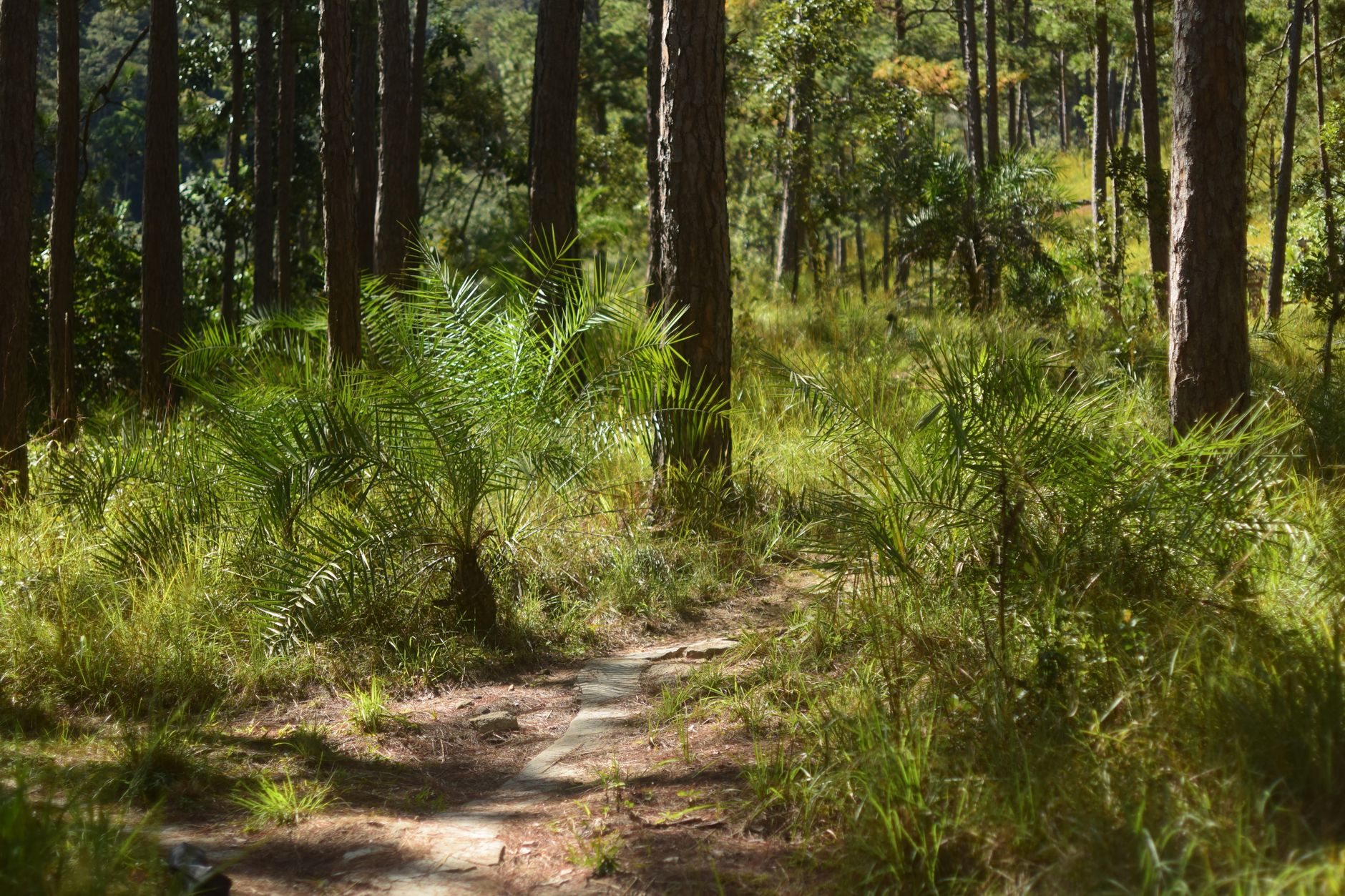
To understand Madagascar’s tortoises, you have to understand the spiny forest, because the two are inseparable. The spiny forest of the south and southwest is one of the strangest and most magnificent habitats on Earth — a thicket of tall, slender octopus trees (Didierea) bristling with spines, fat-trunked baobabs, and a tangle of thorny, drought-adapted plants found almost nowhere else. It is a forest that looks like it belongs on another planet, shaped entirely by the need to survive long, brutal dry seasons.
This is the radiated and spider tortoises’ world. The thorny cover hides them from predators and the relentless sun, the low scrub provides the plants they graze, and the deep-rooted vegetation pulls up the scarce water that keeps the whole system going. When the spiny forest is cleared, the tortoises have nowhere to go — which is why protecting this habitat is the single most important thing for their long-term survival.
It helps to think of the tortoise and its forest as a single thing rather than two. The tortoise’s slow metabolism, its ability to go without water, its low, armoured body that slips beneath the thorns — all of it is an answer to the questions the spiny forest poses. Lose the forest and you do not simply relocate the tortoise; you remove the entire context that its body has spent millions of years answering. This is why conservationists talk less about saving individual tortoises and more about saving habitats: a protected stretch of spiny forest shelters not just tortoises but lemurs, birds, reptiles, and an extraordinary flora found nowhere else. When you walk through it on a guided trail, you are walking through one of the last intact examples of an ecosystem that is vanishing — and your visit, channelled through the reserves that protect it, is part of what gives that forest an economic reason to keep standing. Visiting the spiny forest is also one of the great experiences of southern Madagascar in its own right, and tortoise-watching is best understood as one chapter of a broader southwestern adventure. Our guide to the best of Toliara and the southwest explains how the spiny forest fits into a trip through this remarkable corner of the island.
Ethical Tortoise Tourism — How to Do No Harm
Because tortoises are so heavily exploited, how you behave as a traveller genuinely matters. The single most important rule is simple and absolute: never buy a tortoise, a tortoise shell, or anything made from one, and never agree to “help” anyone move or sell a tortoise. Buying a tortoise — even one offered as a “rescue,” even a single juvenile, even from someone who seems kind — feeds the exact trade that is driving these animals extinct. There is no ethical purchase of a wild Malagasy tortoise. Full stop.
Beyond that, a few principles keep your visit clean. Do not handle wild tortoises; let them move and behave naturally, and keep a respectful distance for photos. Visit only managed reserves, national parks, and recognised conservation or breeding centres, and book through reputable operators and guides who work with those sites — your visitor fees help fund protection. Be wary of anyone offering close-up tortoise encounters outside a proper conservation context, and never share precise locations of wild tortoises online, as that information can be exploited by poachers. If you witness tortoises being sold, kept, or trafficked, report it to your guide, your operator, or the relevant authorities rather than intervening directly. Travelling this way means your trip becomes part of the solution rather than another pressure on already fragile populations.
How to Plan a Trip to See Madagascar’s Tortoises
Tortoise-watching is rarely a trip on its own — it is best built into a broader journey through the south and southwest, combining the spiny forest with the region’s lemurs, birds, baobabs, and beaches. The practical backbone of any such trip is a private vehicle with a knowledgeable driver-guide, because the south’s distances are long, the roads are rough, and the best tortoise sites are scattered and often hard to reach independently.
A typical route arrives via Toliara (usually by domestic flight or down the legendary southern road), bases around Toliara or Ifaty for spiny-forest walks, and ranges out to reserves like Tsimanampetsotsa and the private forests where tortoises are reliably seen — ideally paired with a visit to a conservation breeding centre if one is accessible. From there it can extend deeper south or loop back north. For organised options, our companion guides to Madagascar tortoise tour packages and the realistic cost of a Madagascar tortoise tour lay out what to expect and what to budget. Tortoise-watching also pairs naturally with a wider wildlife focus — see our overview of a Madagascar safari — and you can browse curated southern wildlife excursions on GetYourGuide. To weave it all into a full route, start from our best Madagascar itinerary guide.
Because the south is remote and self-driving is genuinely difficult, most travellers who want to find tortoises do best with a resident specialist arranging the logistics. You can arrange a car and driver on Carla to handle the long southern distances comfortably, and a good driver-guide is also your best protection against unethical “wildlife” offers along the way.
Photographing Madagascar’s Tortoises
Tortoises are, in one sense, the easiest of all Madagascar’s wildlife to photograph: they do not flee, they do not blur, and they hold a pose better than any chameleon. The radiated tortoise’s star pattern in particular rewards careful, close, low-angle photography that brings out the geometry of the shell. Shoot in the softer light of early morning or late afternoon when the spiny forest glows and the heat haze is gentler, get down to the tortoise’s eye level for a more intimate frame, and let the surreal forest of octopus trees and baobabs into your composition to tell the story of where the animal lives.
The one rule that overrides all technique: do not move, reposition, or stage a tortoise for a better shot. Photograph it where you find it, on its own terms, and never block its path. For more on getting the best images across Madagascar’s landscapes and wildlife, see our full guide to Madagascar photography. And if you also want to photograph the island’s reptilian masters of disguise, pair this with our complete guide to the chameleons of Madagascar and the elusive fossa.
Getting There and Travelling Well
Madagascar’s tortoises live at the end of long journeys, and the journey starts with your international flight into Antananarivo, usually via a European or regional hub, followed by domestic travel down to Toliara and the south. Long-haul travel to a remote island always carries the risk of delays, cancellations, and missed connections, so it pays to protect yourself.
If your inbound flight is routed through Europe and is delayed or cancelled, you may be entitled to compensation under EU air-passenger rules — EU261 covers up to €600 per passenger on disrupted European inbound flights. Note that this applies only to the European-routed international flight, not to Madagascar’s domestic legs. Just as importantly, the rough roads, remote reserves, and limited medical facilities of the deep south make solid travel insurance essential. We recommend SafetyWing Nomad Insurance for its flexible, traveller-friendly coverage that suits long trips into remote areas — exactly the kind of journey a southern tortoise quest involves. Don’t head into the spiny forest without SafetyWing coverage in place.
Let Carla Plan Your Southern Wildlife Trip
The deep south is one of the most rewarding and most logistically demanding parts of Madagascar, and tortoise-watching done ethically takes local knowledge — which reserves are genuinely conservation-minded, which centres allow respectful visits, and how to time forest walks for active animals. A resident specialist takes all of that off your plate. Contact Carla to build a southern Madagascar trip that puts you in front of wild radiated tortoises and the spiny forest they call home, ethically and comfortably, and to arrange the car and driver that makes the long southern roads painless. For the broader wildlife picture, you can also browse southern wildlife tours on GetYourGuide.
Frequently Asked Questions
What is the rarest tortoise in Madagascar?
The ploughshare tortoise, known locally as the angonoka (Astrochelys yniphora), is widely considered the rarest tortoise on Earth. It lives only in a small area of dry forest in the northwest around Baly Bay, and only a few hundred are thought to survive in the wild. The illegal pet trade has driven it to the brink, and most travellers will only ever see one at a conservation breeding centre rather than in the wild.
Where can I see wild tortoises in Madagascar?
The best places are in the arid south and southwest, especially the spiny forests around Toliara (Tuléar) and Ifaty, protected areas such as Tsimanampetsotsa National Park, and private reserves and forest parks in the deep south. The radiated tortoise is the species you are most likely to encounter on a guided walk. The rarest species, like the ploughshare, are realistically only seen at conservation breeding centres.
Are Madagascar’s tortoises the same as sea turtles?
No. Madagascar’s tortoises are land animals that live in dry forest and scrub far from the sea, with dome-shaped shells and stumpy legs. Sea turtles are an entirely separate, ocean-going group that come ashore on beaches to nest. Both occur in Madagascar, but seeing tortoises means heading into the spiny forest of the south, while seeing marine turtles is a coastal or island experience.
Can I buy a tortoise in Madagascar?
Absolutely not. Buying a tortoise — or a shell or anything made from one — is illegal and directly fuels the trafficking crisis that is driving these species toward extinction, even if it is presented as a “rescue.” Never buy, handle, or help move a wild tortoise. The single most ethical thing a traveller can do is refuse the trade entirely and visit only managed reserves and recognised conservation centres.
When is the best time to see tortoises in Madagascar?
Tortoises in the south are far more active in the warmer, wetter months, when rain triggers feeding and movement; during the harshest dry season they shelter and stay inactive. Many travellers aim for shoulder timing — warm enough for active tortoises, manageable enough for the south’s rough roads. Check our best-time-to-visit guide and tell your guide that active tortoises are a priority so they can plan forest walks accordingly.
🐢 Plan an Ethical Tortoise & Wildlife Trip — Ask Carla
Get a southern-Madagascar trip that includes the spiny forest and ethical, conservation-minded tortoise sites, by a resident specialist. Reach out to Carla.
Plan Your Trip to Madagascar
- Read the full Madagascar Travel Guide
- Explore itineraries by style and duration
- Explore the full destination guide
Where to Stay